Swimming Pool Water Treatment in Oman: Best Practice Guide 2026
Swimming pool water treatment in Oman is not the same job it is in Europe or India. Make-up water in Muscat often arrives at 300-600 ppm TDS with high calcium hardness, evaporation in July runs 10-12 mm a day, and bather loads at hotels and compounds spike every weekend. Get the chemistry wrong and you get cloudy water, scaled tile lines, corroded heat exchangers and a health inspection you would rather not have.
This guide covers how we approach swimming pool water treatment in Oman across hotels, school pools, villa compounds and gym facilities, and what the equipment room should actually contain.
On this page
- Target water quality values
- Equipment room: what you need
- Chemicals and dosing
- The Oman hard water problem
- Testing and service schedule
- Five mistakes we fix most often
- FAQ
Target water quality values
These are the operating bands we hold pools to. They follow WHO guidelines for safe recreational water environments and the ranges municipal inspectors in Oman look for.
| Parameter | Target | Why it matters |
|---|---|---|
| Free chlorine | 1.0-3.0 mg/L | Below 1.0 mg/L disinfection fails; above 3.0 mg/L irritates eyes and skin |
| pH | 7.2-7.8 | Outside this band chlorine loses effectiveness and metal parts corrode |
| Total alkalinity | 80-120 mg/L | Buffers pH against sudden swings |
| Calcium hardness | 200-400 mg/L | High in most Oman supply water; drives scale on tiles and heaters |
| Cyanuric acid | Under 50 mg/L | Stabiliser build-up locks up chlorine |
| Turbidity | Under 0.5 NTU | Cloudy water means the filter or coagulation is failing |
| Combined chlorine | Under 0.2 mg/L | The chloramine smell people blame on “too much chlorine” |
Equipment room: what you need
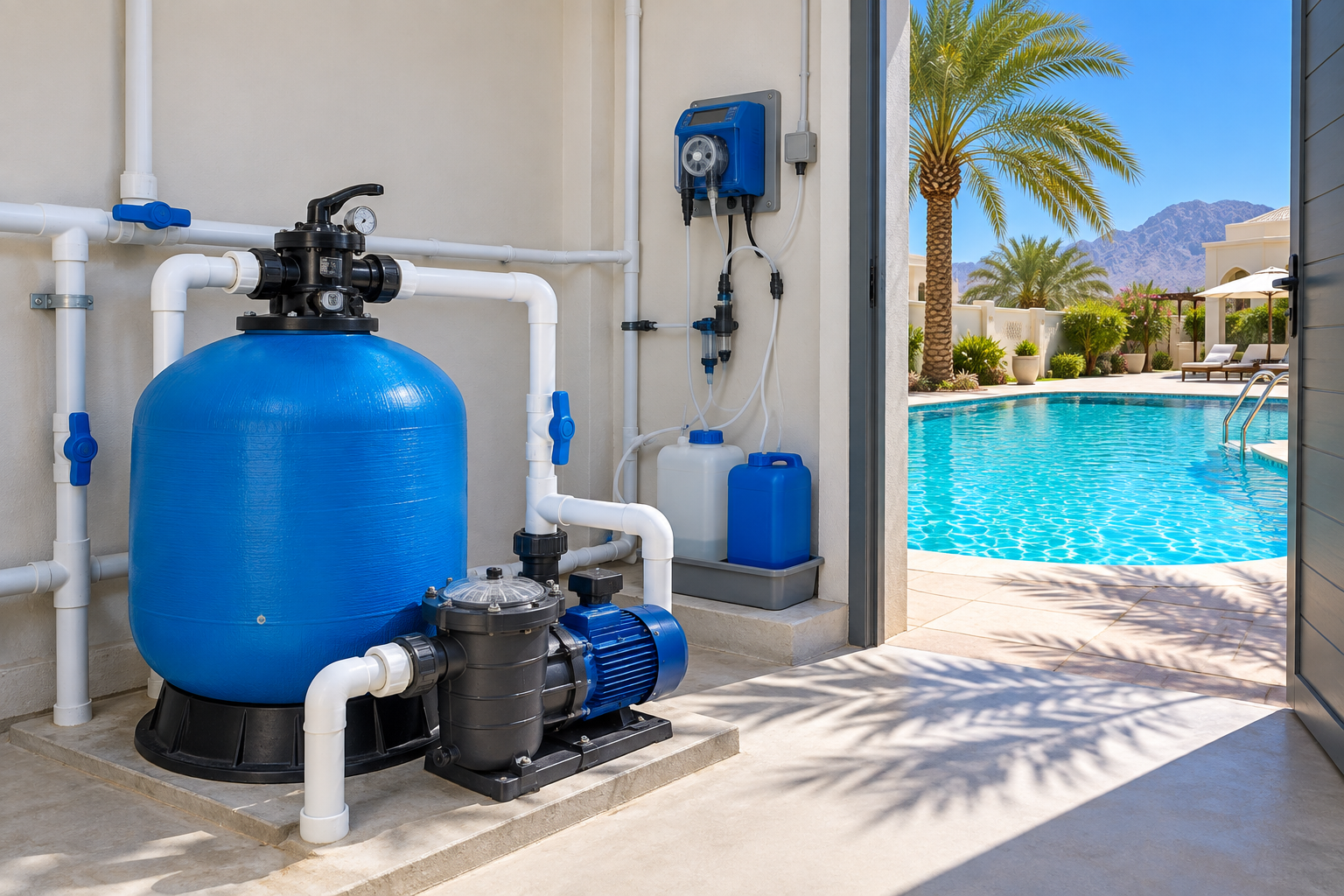
A pool that holds its numbers without daily firefighting has five things in the plant room:
- Circulation pump sized for a full turnover in 4-6 hours for a public pool, 6-8 hours for a villa pool.
- Sand or glass media filter rated for the flow, with a working multiport valve and a pressure gauge nobody has painted over. Backwash when pressure rises 0.5 bar above clean.
- Automatic dosing pumps for hypochlorite and acid, driven by a pH and ORP controller rather than a timer.
- UV or ozone secondary disinfection on high-load pools. It cuts chloramines and lets you run chlorine at the low end of the band.
- Balance tank and skimmers that are actually skimming, not running dry at half load.
Timer-only dosing is the single most common weak point we find. A controller that reads the water and doses to setpoint is the difference between swimming pool water treatment in Oman that runs itself and a pool the facilities team babysits.
Chemicals and dosing

- Calcium hypochlorite (65-70%) granular, for shock and routine chlorination. Adds calcium, so watch hardness on pools already running high.
- Sodium hypochlorite (10-12%) liquid, for automatic dosing. Loses strength in Oman summer storage, so buy in rotation and keep drums shaded.
- Hydrochloric acid or sodium bisulphate to bring pH down, which is the usual direction of travel here.
- Sodium bicarbonate to lift alkalinity when it drops after heavy acid dosing.
- Clarifier or flocculant for persistent cloudiness that backwashing alone does not clear.
- Algaecide as a preventive on outdoor pools through summer.
- Scale and stain inhibitor on hard make-up water, the same family of chemistry as an RO antiscalant.
The Oman hard water problem
Most pool complaints we are called out to in Muscat trace back to make-up water, not to dosing. Evaporation leaves the minerals behind, so calcium hardness and TDS climb all summer while the volume stays the same. The scale line on the tiles, the rough patches on the plaster, the heater that lost its output: all the same cause. See our note on hard water in Oman for the background.
Two fixes work. Soften or partially treat the make-up line so you stop adding hardness every top-up, or plan a partial drain-down each year to reset TDS. On large hotel pools we usually do both, and feed the make-up line through a softener sized for the daily top-up rather than the pool volume.
Testing and service schedule
| Task | Frequency |
|---|---|
| Free chlorine and pH test | Twice daily on public pools, daily on villa pools |
| Alkalinity, calcium hardness, cyanuric acid | Weekly |
| Filter backwash | Weekly, or at 0.5 bar pressure rise |
| Dosing pump calibration and probe clean | Monthly |
| Microbiological lab test | Monthly on public and hotel pools |
| Filter media replacement | Every 3-5 years |
| Partial drain and refill | Annually, based on TDS |
Keep the log sheet in the plant room and signed. When an inspector asks, a twelve-month record of readings settles the conversation faster than any certificate.
Five mistakes we fix most often
- Chasing chlorine while pH sits at 8.2. At that pH most of your chlorine is doing nothing. Fix pH first, every time.
- Shocking a pool in the afternoon. Dose after sunset. UV burns off unstabilised chlorine within hours.
- Stabilised chlorine as the daily product. Cyanuric acid accumulates, locks up the chlorine, and the only cure is draining water.
- Undersized circulation. No chemical programme rescues a pool turning over in twelve hours.
- Ignoring make-up water. Covered above, and the reason behind most scale callouts.
FAQ
How much does swimming pool water treatment in Oman cost?
Monthly service for a villa pool typically runs well below the cost of a single scale-related heater replacement. Chemicals, testing and filter service on a hotel pool are quoted against volume, bather load and the equipment already installed. We quote per site after a plant room survey.
Can I use drinking water RO reject to top up my pool?
No. Reject water carries two to four times the TDS of the feed, so you would be accelerating exactly the problem you want to avoid.
Why does my pool smell strongly of chlorine?
That smell is chloramines, which form when chlorine is too low relative to bather load, not too high. Shock the pool and check your free versus combined chlorine split.
Do I need UV on a pool that already has chlorine?
Not on a lightly used villa pool. On a hotel, school or gym pool with heavy load, UV cuts chloramines, reduces chemical consumption and removes the complaints about irritated eyes.
How often should the pool be drained completely?
A full drain is rarely needed and risks structural damage on in-ground pools. A partial drain of 20-30% once a year, sized against measured TDS, achieves the same reset.
Get your pool assessed
UV Water Systems has handled water treatment in Oman since 2012, including pool chemical supply and plant room service for hotels, compounds and government facilities. Call +968 9763 7786 or email sales@waterfilteroman.com for a plant room survey and a quotation.