Aquaculture Water Filtration Oman: 7 Proven Steps for Healthy Fish Farms
Aquaculture water filtration Oman fish and shrimp farmers depend on decides whether a crop grows fast or dies overnight. Fish live, eat, breathe and excrete in the same water, so the water quality you keep is the single biggest factor in survival rate, growth and feed cost. This guide explains how filtration works on a fish farm, which equipment you need, and how to size a system for Oman’s conditions.
Oman is expanding aquaculture under Vision 2040, with shrimp, sea bream, tilapia and grouper projects along the coast and inland. Each one faces the same problem: high temperatures, high salinity or brackish well water, and a limited supply of clean intake water. A well-designed aquaculture water filtration Oman setup solves all three.
Aquaculture Water Filtration Oman: Why It Matters
Summer water temperatures in Oman can pass 32°C. Warm water holds less dissolved oxygen, and fish metabolism speeds up, so ammonia builds faster. At the same time, uneaten feed and solid waste rot and feed bacteria. Without filtration, you see:
- Ammonia and nitrite spikes that damage gills and kill stock
- Low dissolved oxygen, especially at night
- Cloudy water that hides disease and stresses fish
- Bacterial and parasite outbreaks that spread across the whole farm
- Higher feed conversion ratio (FCR), meaning more feed for less fish
Target Water Quality for Fish and Shrimp Farms
| Parameter | Typical Target |
|---|---|
| Dissolved oxygen | Above 5 mg/L |
| Total ammonia nitrogen (TAN) | Below 1 mg/L |
| Nitrite (NO₂) | Below 0.5 mg/L |
| pH | 6.5 – 8.5 (species dependent) |
| Total suspended solids | Below 25 mg/L |
| CO₂ | Below 15 mg/L |
Exact limits depend on species, so confirm with your hatchery or biologist. The FAO aquaculture resources are a reliable reference.
7 Proven Steps in Aquaculture Water Filtration Oman Systems
1. Intake screening and sand filtration
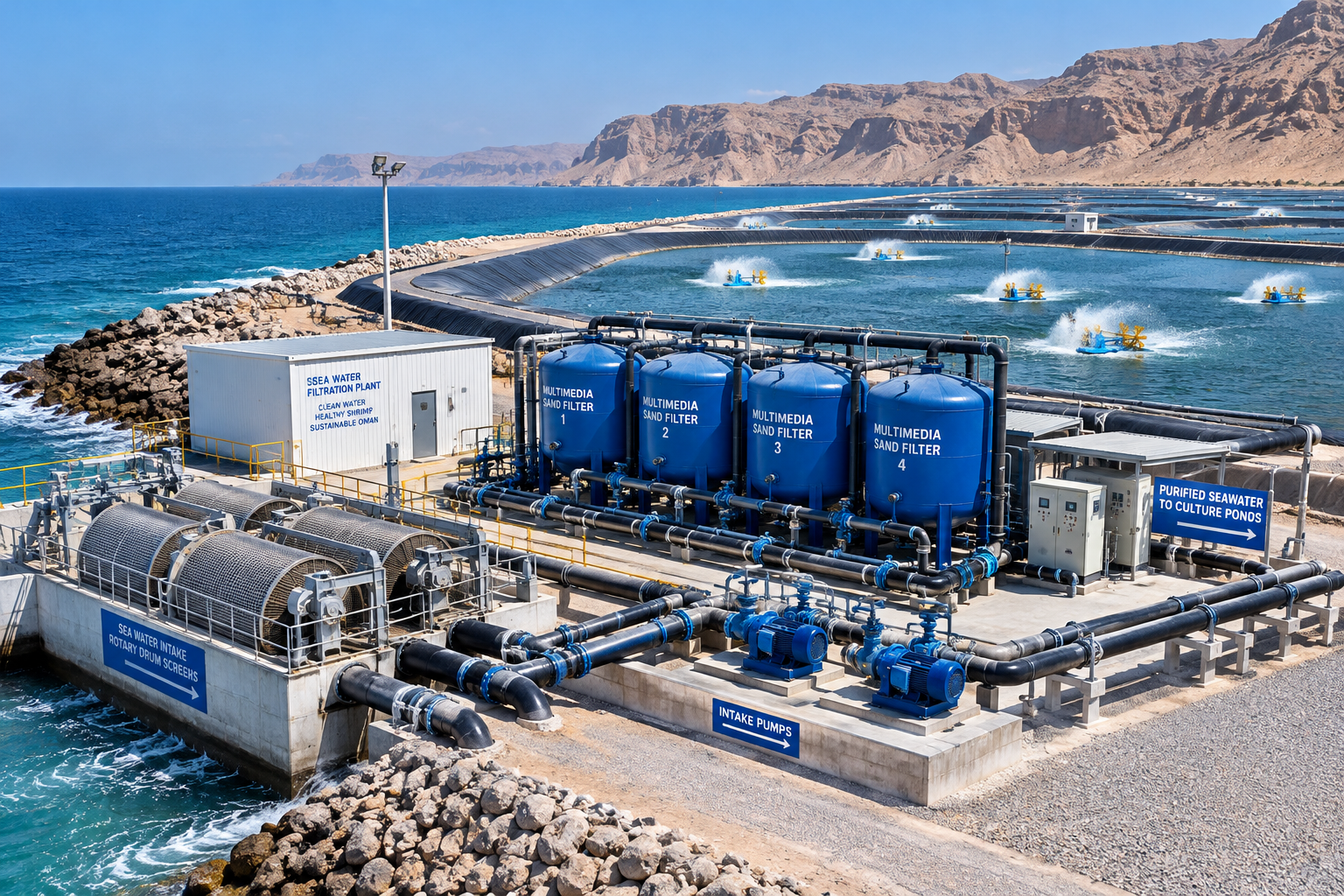
Raw seawater or well water first passes through screens and a sand or multimedia filter. This removes sand, silt, algae and larger particles before the water reaches your tanks or ponds.
2. Mechanical filtration (drum filter)
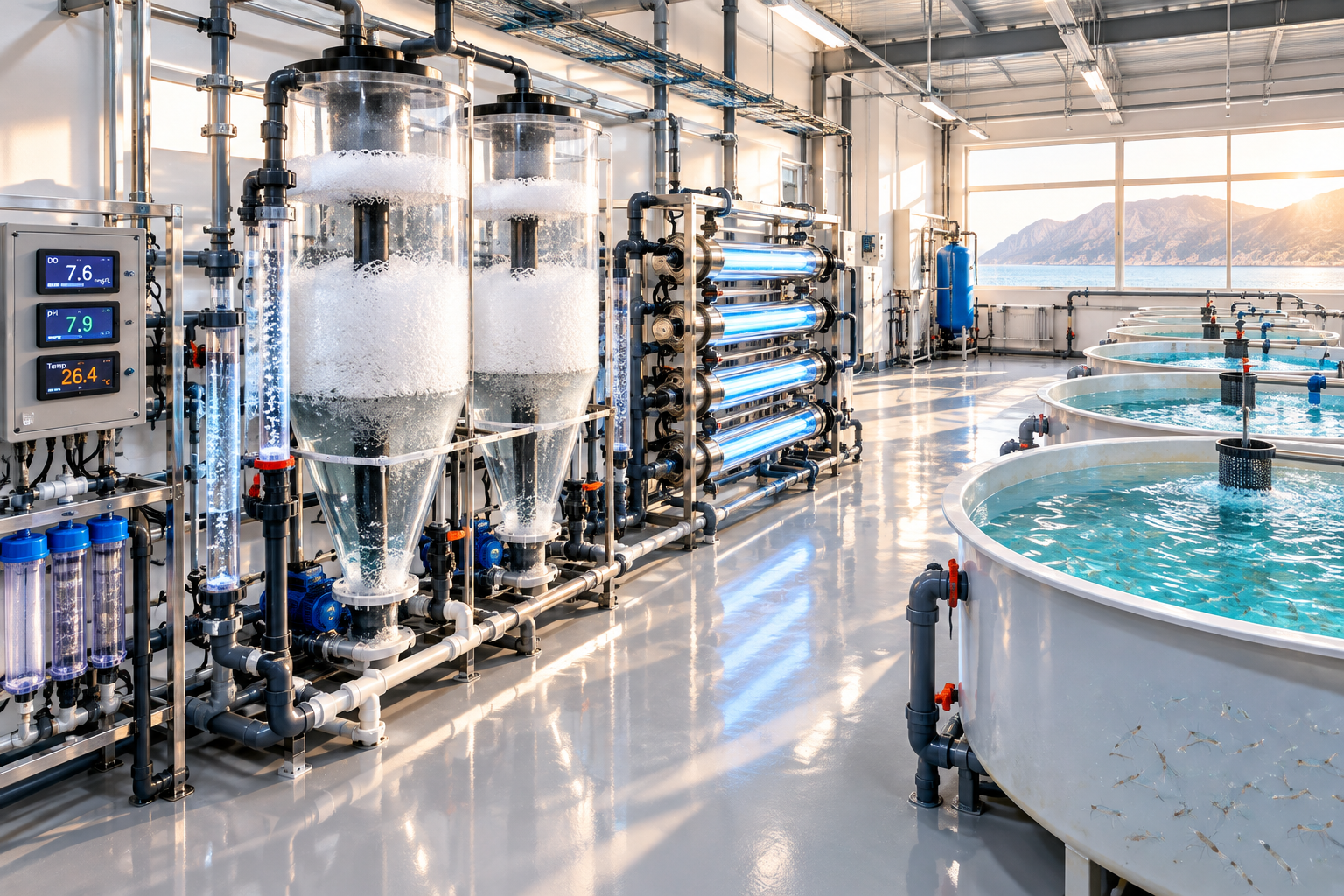
In recirculating systems, a rotating drum filter with 40–100 micron mesh removes fish waste and uneaten feed within minutes. Removing solids early cuts the load on every stage after it.
3. Biological filtration
A moving bed biofilm reactor (MBBR) or trickling filter grows nitrifying bacteria that convert toxic ammonia into nitrite and then into safer nitrate. This is the heart of any recirculating aquaculture system (RAS).
4. Protein skimmer for marine systems
For seawater species, a protein skimmer (foam fractionator) strips fine organics and dissolved proteins that mechanical filters miss.
5. Degassing and oxygenation
A degassing column removes CO₂, and oxygen cones or diffusers raise dissolved oxygen back to safe levels before water returns to the tanks.
6. UV sterilization
A UV sterilizer kills free-floating bacteria, viruses and parasites, and controls green water from algae. Correct UV dose and flow rate matter. An undersized unit gives a false sense of safety.
7. RO and water conditioning for hatcheries
Hatcheries and freshwater species often need low-salinity, stable water. A reverse osmosis plant treats brackish well water, and dosing systems adjust pH, alkalinity and minerals to the level the species needs.
RAS vs Flow-Through Systems
Flow-through farms take in fresh water continuously and discharge it, which needs a large water source. RAS reuses 90–99% of its water through the filtration loop above. In Oman, where water is scarce and land near the coast is expensive, RAS is becoming the preferred option for hatcheries, nurseries and high-value species, and it relies completely on aquaculture water filtration Oman farms can maintain locally.
How to Size Aquaculture Water Filtration Oman Equipment
Sizing starts with three numbers: total water volume, stocking density (kg of fish per m³), and daily feed quantity. Feed drives ammonia production, so it drives biofilter size. Most RAS designs turn the full tank volume over once every 30–60 minutes. Our engineers calculate drum filter mesh, biofilter media volume, UV dose and pump capacity from your farm data.
Maintenance Checklist
Even the best aquaculture water filtration Oman system fails without routine care.
- Test ammonia, nitrite, pH and oxygen daily
- Check drum filter spray nozzles and mesh weekly
- Backwash sand filters as pressure rises
- Clean UV quartz sleeves monthly and replace lamps every 9,000 hours
- Never clean biofilter media with chlorinated water
Aquaculture Water Treatment Support from UV Water Systems
UV Water Systems has supplied water treatment in Oman for over 14 years and is ISO 9001:2015 certified. We design and supply sand filters, UV sterilizers, RO plants and chemical dosing systems for farms, hatcheries and research labs, and we support aquaculture water filtration Oman projects from design to commissioning. Browse our water treatment products, then call or WhatsApp +968 9763 7786 for a site visit and system design.