Coffee Machine Water Filter Oman: Stop Scale Before It Kills Your Equipment
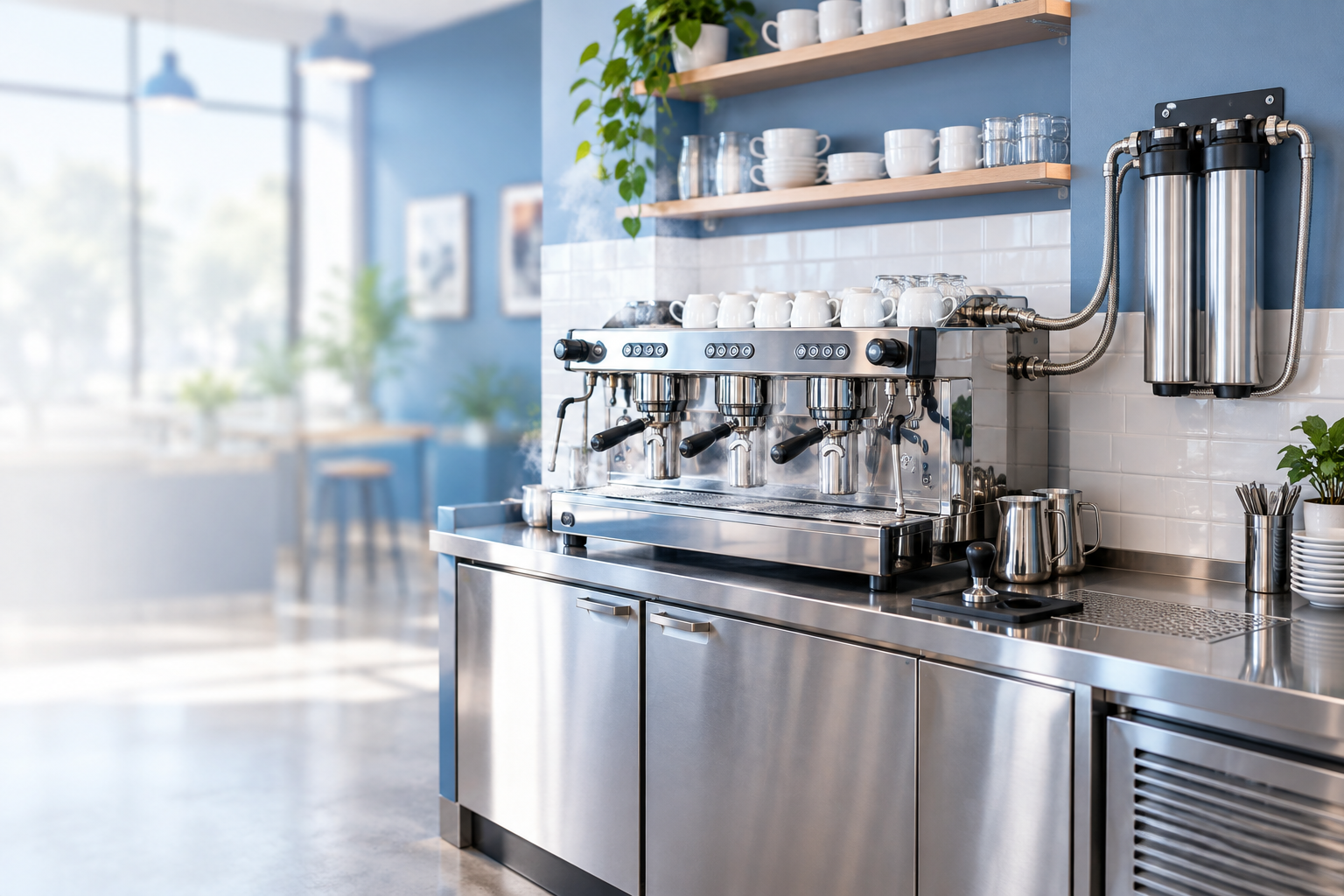
A commercial espresso machine in Muscat fails for one reason more than any other: scale. Not a faulty boiler, not a bad pump, not the barista. Calcium and magnesium out of the mains supply bake onto the heating element every time the machine heats water, and within months the group head temperature drifts, the steam pressure drops, and the service engineer quotes you 200 OMR for a descale that should never have been needed.
A coffee machine water filter costs a fraction of that and it is the single cheapest piece of equipment in the shop.
Why Oman water is hard on coffee equipment
Mains supply across Muscat and most of the Batinah is desalinated seawater blended with groundwater. The blend varies by area and by season. Typical hardness runs between 120 and 300 ppm as CaCO3, and TDS commonly sits in the 200 to 600 ppm range depending on where the building draws from. Anything above roughly 100 ppm hardness will scale a boiler that runs at 90 to 120 degrees all day.
Three things happen as scale builds:
- Heat transfer drops. A 1 mm scale layer on the element costs you roughly 10% more energy for the same shot temperature.
- Temperature stability goes. Espresso extraction is sensitive to 1 degree. Scaled boilers swing by 5 or more.
- Components fail. Solenoid valves, flow meters and level probes all clog. Ice makers get the worst of it because they cycle cold and warm continuously.
If you already know your supply is hard, our guide on hard water in Oman covers the household side of the same problem.
What the filter actually has to do
A cafe filter has four jobs, and most cheap cartridges only do one of them.
| Job | Why it matters | Media that does it |
|---|---|---|
| Remove chlorine and taste | Chlorine ruins the cup and degrades machine seals | Activated carbon block |
| Control scale | Protects boiler, element and valves | Ion exchange resin or polyphosphate |
| Hold minerals for flavour | Zero-mineral water extracts flat, sour coffee | Blend valve or partial softening |
| Trap particles | Protects flow meters and solenoids | 5 micron pre-filter |
The mistake we see most often is a full RO system plumbed straight into an espresso machine with no remineralisation. The water is clean, the scale problem is gone, and the coffee tastes hollow. Baristas then over-dose to compensate and burn through beans. Water for espresso wants roughly 50 to 150 ppm TDS and 40 to 70 ppm hardness, not zero.
Choosing by equipment type
Espresso machines
A carbon block plus ion exchange cartridge sized to the shop’s volume. A two-group machine pulling 150 shots a day needs a cartridge rated around 3,000 to 6,000 litres. Fit a bypass blend valve so you can dial the hardness rather than strip it out entirely.
Ice makers
Ice machines scale faster than anything else in the kitchen because the evaporator plate cycles constantly. They need scale control and sediment removal, and they do not need mineral balance the way espresso does. A dedicated cartridge here pays for itself inside a year in avoided callouts.
Combi ovens and steamers
These run the highest duty cycle of all and most manufacturers void the warranty without treated feed water. A small softener or a DI polishing stage is usually the right answer rather than a cartridge.
Multi-outlet kitchens
Once you have three or more pieces of equipment, stop buying cartridges per machine. A central softener feeding the whole kitchen line, with point-of-use carbon at each machine, is cheaper to run and easier to service. Our water softener price guide for Oman gives the cost ranges.
What it costs to get this wrong
Take a two-branch cafe with one three-group machine and one ice maker per branch. Unprotected, expect a descale service every 4 to 6 months per machine, a boiler element replacement inside two years, and an ice maker evaporator well before its rated life. Against that, a correctly specified filter set and a cartridge change twice a year is a rounding error on the P&L.
The hidden cost is worse than the repair bill. A machine down at 8 AM on a weekday costs you the morning rush, and in a market where customers pick by habit, a week of bad coffee moves them somewhere else permanently.
Service intervals that actually work in Oman
- Sediment pre-filter: every 3 months. Sooner in Sohar, Duqm and anywhere on a tanker supply.
- Carbon block: every 6 months, or by litre count if the machine has a meter.
- Scale cartridge: by volume, not by calendar. Track it.
- Softener resin: check hardness monthly with a test kit; regeneration settings drift as feed water changes season to season.
Cartridge life quoted by the manufacturer assumes European feed water. In Oman, halve it and then measure. Our cartridge replacement schedule explains how to set intervals by stage.
Test before you buy
Do not specify a filter from a brochure. Take a sample from the actual tap that will feed the machine and get hardness, TDS, chlorine and pH. A 20 OMR test stops you from buying the wrong system twice. If you want to understand the numbers first, read our note on TDS levels in Muscat water.
How we work with hospitality clients
UV Water Systems supplies and services filtration for cafes, restaurants and hotel kitchens across Oman, including branches of Tim Hortons, Dunkin and Paul, and the cafe operations at Oman Oil stations. We size from a water test, install without shutting your kitchen down, and put you on a scheduled cartridge plan so nobody has to remember.
Send us a photo of your machine and a water sample location and we will come back with a specification and price.
We assure the quote is in line with your requirement.
In case of any additional info please feel free to contact the undersigned.
Thanks & Regards
Fasalu Rahman
Product Specialist | Water Treatment Division
ISO 9001:2015 Quality Certified
Uniqueness View LLC | Muscat, Sultanate of Oman
M: +968 9763 7786
W: www.uvwater.biz
Coffee Machine Water Filter Selection Checklist
A coffee machine water filter should be selected from measured hardness, alkalinity, TDS and daily water use. Check the cartridge capacity at the actual Oman feed-water hardness, not only the manufacturer’s headline litre rating. Install a bypass or blending valve when the espresso machine needs controlled mineral content for extraction.
Record the installation date and outlet hardness, then test monthly. Replace the coffee machine water filter by treated volume or when outlet hardness rises; do not wait for scale to appear inside the boiler. The Specialty Coffee Association standards provide an external technical reference for coffee equipment and brewing-water requirements.