Cooling Tower Dosing Systems in Oman: Automatic Control for Scale, Corrosion and Bacteria
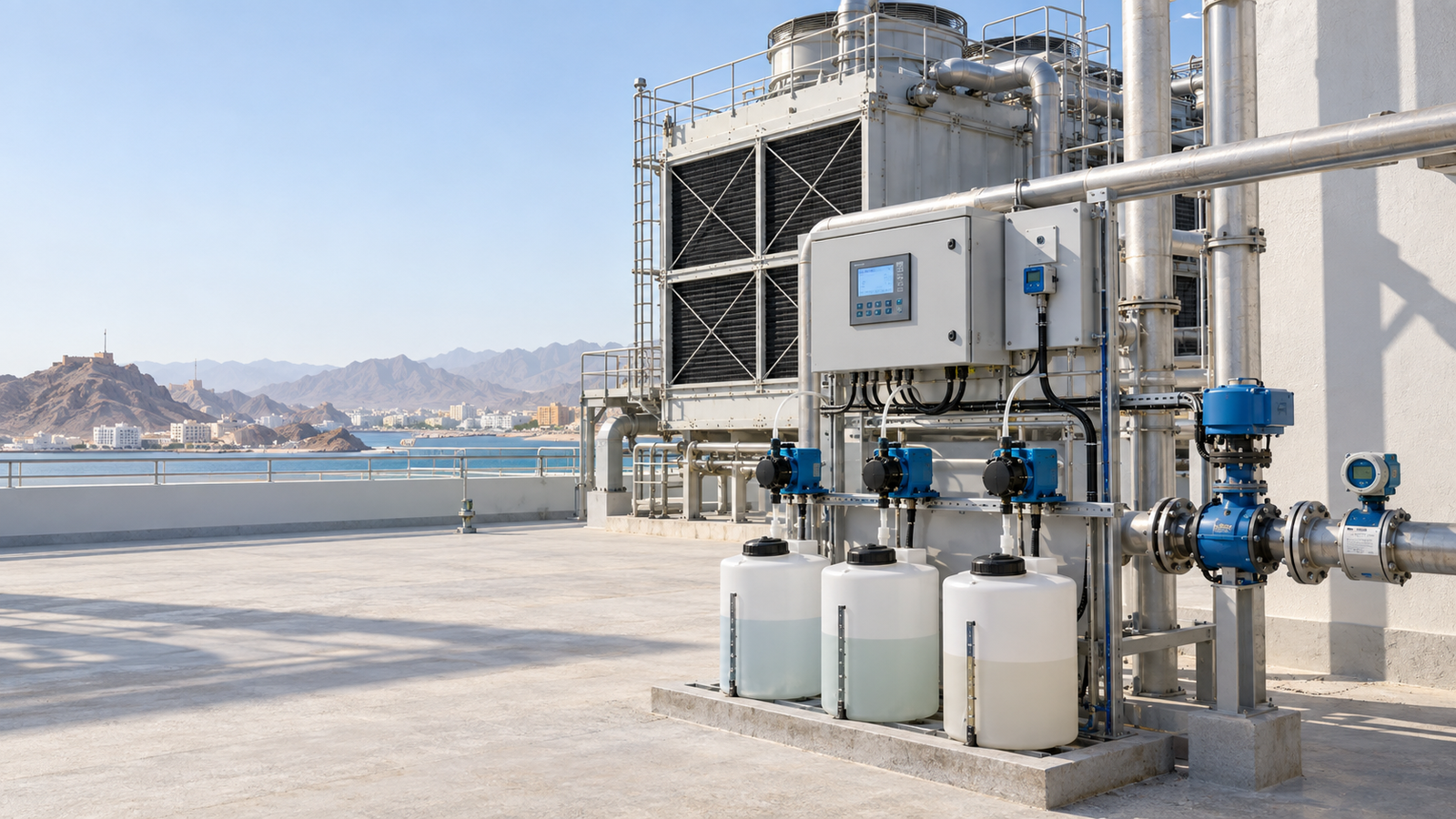
Cooling tower dosing system Oman facilities need accurate chemical dosing and blowdown control because evaporation continuously concentrates dissolved minerals. Without automatic control, circulating water can develop scale, corrosion and microbiological growth, reducing heat-transfer efficiency and equipment life.
An automatic system measures the circulating water and adjusts treatment according to real operating conditions. In Oman, high ambient temperatures and variable make-up water quality place heavy demands on cooling equipment, making automatic control more dependable than manual chemical addition.
What Does a Cooling Tower Dosing System Oman Package Control?
A properly configured package combines monitoring, chemical dosing and bleed control. The EMEC MTOWER complete dosing system supplied by UV Water Systems coordinates:
- Conductivity measurement with temperature compensation
- Automatic blowdown at the selected conductivity setpoint
- Inhibitor dosing for scale and corrosion control
- Two independent biocide dosing programmes
- Make-up and bleed water-meter inputs
- Flow verification and low-chemical-level alarms
- High and low conductivity, bleed-timeout and no-flow alarms
The controller can operate inhibitor dosing through feed-and-bleed, as a percentage of bleed or time, from a pulse-output water meter, or through a PPM-based setup. This allows the treatment programme to match the cooling-system design and operating pattern.
Why Conductivity and Automatic Blowdown Matter
Evaporation removes pure water while leaving dissolved salts behind. As concentration rises, calcium salts, silica and other minerals can deposit on heat-transfer surfaces. An automatic conductivity controller opens the motorised blowdown valve when conductivity reaches the programmed limit. Fresh make-up water then replaces the discharged concentrated water.
Correct blowdown protects the system without wasting more water than necessary. The final setpoint must be based on make-up water quality, the selected treatment chemical and the acceptable cycles of concentration.
Three Dosing Pumps for Complete Chemical Control
A complete programme normally uses three independent chemical dosing pumps:
- An inhibitor pump for scale and corrosion control.
- A primary biocide pump for microbiological control.
- A secondary biocide pump for an alternating biocide programme.
Separate tanks and suction assemblies keep each chemical segregated. Injection points, pump capacity and tank volume must be selected according to system volume, water consumption and the chemical supplier’s recommended dose.
Applications in Oman
Automatic cooling-water dosing is suitable for hotels, hospitals, commercial buildings, shopping centres, factories, food facilities and district-cooling plants. It can be applied to open recirculating cooling towers and evaporative condensers where conductivity, bleed and chemical dosing require coordinated control.
UV Water Systems: Cooling-Water Treatment Support in Oman
UV Water Systems is a leading water-treatment company providing cooling tower and evaporative condenser dosing systems in Oman. We supply EMEC controllers, dosing pumps, chemical tanks, blowdown valves, water meters, probes and the required accessories as one coordinated package.
Our Muscat-based team supports equipment selection, site assessment, installation, commissioning, chemical programmes and after-sales service. Supply-only packages are also available for contractors and facility-management teams.
Contact UV Water Systems to review your cooling-system volume, make-up water analysis and operating requirements before selecting the final pump, tank, valve and meter sizes.
Selection Information Required
Before selecting a cooling tower dosing system Oman operators should confirm the recirculating water volume, make-up water consumption, pipe sizes, operating hours and available electrical supply. A current make-up water analysis should include conductivity, hardness, alkalinity, chlorides and silica. These values help determine the practical cycles of concentration and the required chemical programme.
The dosing pump flow rate must cover the maximum chemical demand while maintaining accurate turndown during normal operation. Tank capacity should provide a sensible refill interval without storing excessive chemical. The water meter, blowdown valve and flow switch must match the actual pipework and hydraulic conditions. UV Water Systems can review these details and prepare a site-specific equipment schedule.