Hospital Water Treatment in Oman: Best Practice for Dialysis and Clinical Water
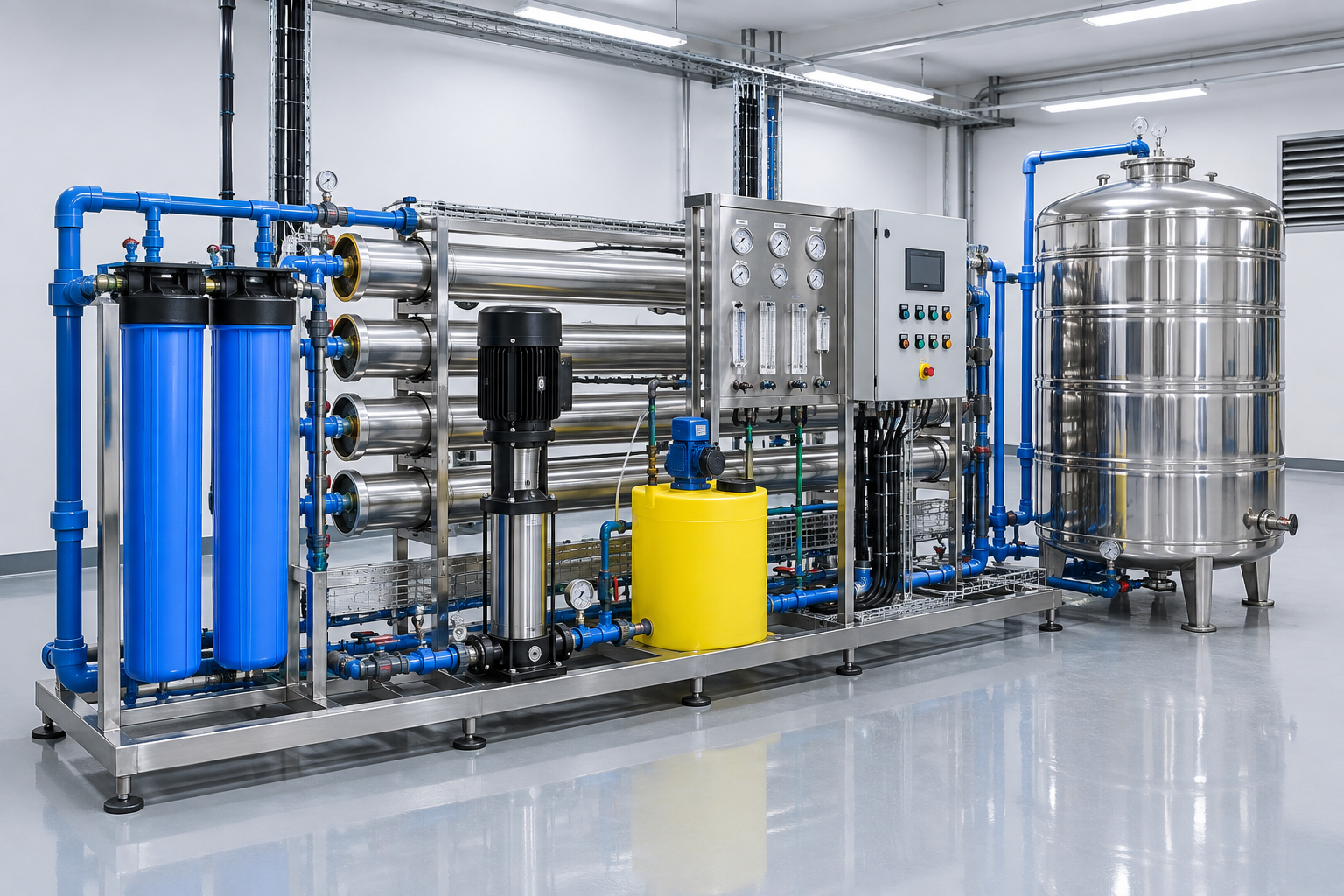
Hospital water treatment in Oman is not one system. A hospital runs several water qualities side by side off the same incoming main: potable water for wards and kitchens, softened water for boilers and laundry, purified water for CSSD autoclaves and lab analysers, and dialysis-grade water held to limits tighter than drinking water by three orders of magnitude. Each one fails differently, and each one has a different inspector asking about it.
This page sets out how we design and maintain hospital water treatment in Oman, what the dialysis loop has to achieve, and where the systems we are called in to rescue usually went wrong.
On this page
- The five water streams in a hospital
- Dialysis water: the limits that matter
- How the dialysis loop is built
- CSSD and laboratory water
- Monitoring and validation
- Where hospital systems fail
- FAQ
The five water streams in a hospital
| Stream | Quality required | Typical plant |
|---|---|---|
| Potable: wards, kitchen, staff | Oman drinking water standard | Sand filter, carbon, UV, tank chlorination |
| Softened: boiler, laundry, HVAC | Under 2 ppm hardness | Duplex softener with brine regeneration |
| Purified: CSSD, autoclaves | Low conductivity, low endotoxin | RO plus DI polishing |
| Laboratory: analysers, reagent water | Type I to Type III by instrument | RO plus mixed bed plus UV plus ultrafilter |
| Dialysis: haemodialysis machines | ISO 23500-3 chemical, bacteria and endotoxin limits | Double-pass RO with a sanitisable ring main |
A single central plant feeding all five is where most problems start. Hospital water treatment in Oman works when the central plant handles pre-treatment and the point-of-use quality is produced close to where it is consumed.
Dialysis water: the limits that matter
Dialysis water is the tightest specification in the building. A patient on haemodialysis is exposed to roughly 120 litres of water across one session, across a membrane, with no gut barrier in the way. The governing standard is the ISO 23500 series on water for haemodialysis, and the WHO guidelines for drinking-water quality set the floor the feed has to clear before the RO even starts.
| Parameter | Dialysis water | Ultrapure dialysate |
|---|---|---|
| Total viable count | Under 100 CFU/mL, action at 50 | Under 0.1 CFU/mL |
| Endotoxin | Under 0.25 EU/mL, action at 0.125 | Under 0.03 EU/mL |
| Aluminium | Under 0.01 mg/L | Same |
| Chloramine | Under 0.1 mg/L | Same |
| Fluoride | Under 0.2 mg/L | Same |
| Nitrate as N | Under 2 mg/L | Same |
Compare the bacteria figure to drinking water and the gap is clear. Chlorine and chloramine are the two that catch people out: both are deliberately in the municipal supply, both pass straight through an RO membrane, and both have to be stripped by carbon ahead of it.
How the dialysis loop is built
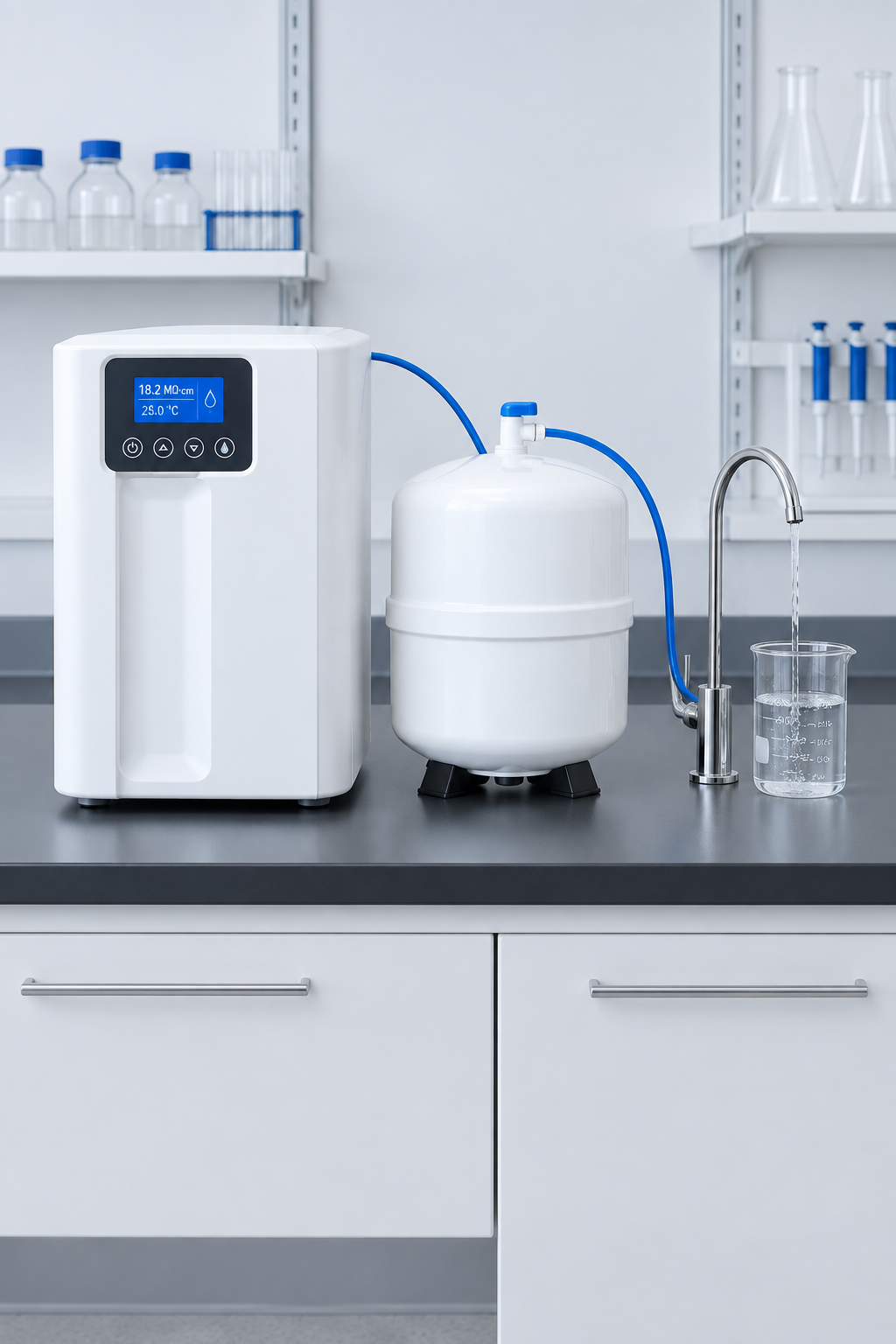
- Break tank and booster to give stable feed pressure independent of main fluctuation.
- Multimedia and softener to take out turbidity and hardness. On Oman feed water the softener is not optional, it is what protects the membranes.
- Dual carbon beds in series with a sample point between them. Chloramine breakthrough is tested at the midpoint before every treatment shift.
- 5 micron cartridge as membrane protection.
- Double-pass RO sized at a minimum of 130% of peak demand, so one pass can be serviced without closing the unit.
- Ring main distribution in PEX or PVDF, with no dead legs, continuous recirculation at turbulent velocity, and heat or chemical sanitisation designed in from day one.
- Ultrafilters at each machine where ultrapure dialysate is the target.
The ring main is the part that cannot be retrofitted cheaply. A dead leg of a few hundred millimetres becomes a biofilm reservoir that no amount of disinfection clears permanently, which is why the pipework drawing matters more than the brand on the RO skid.
CSSD and laboratory water
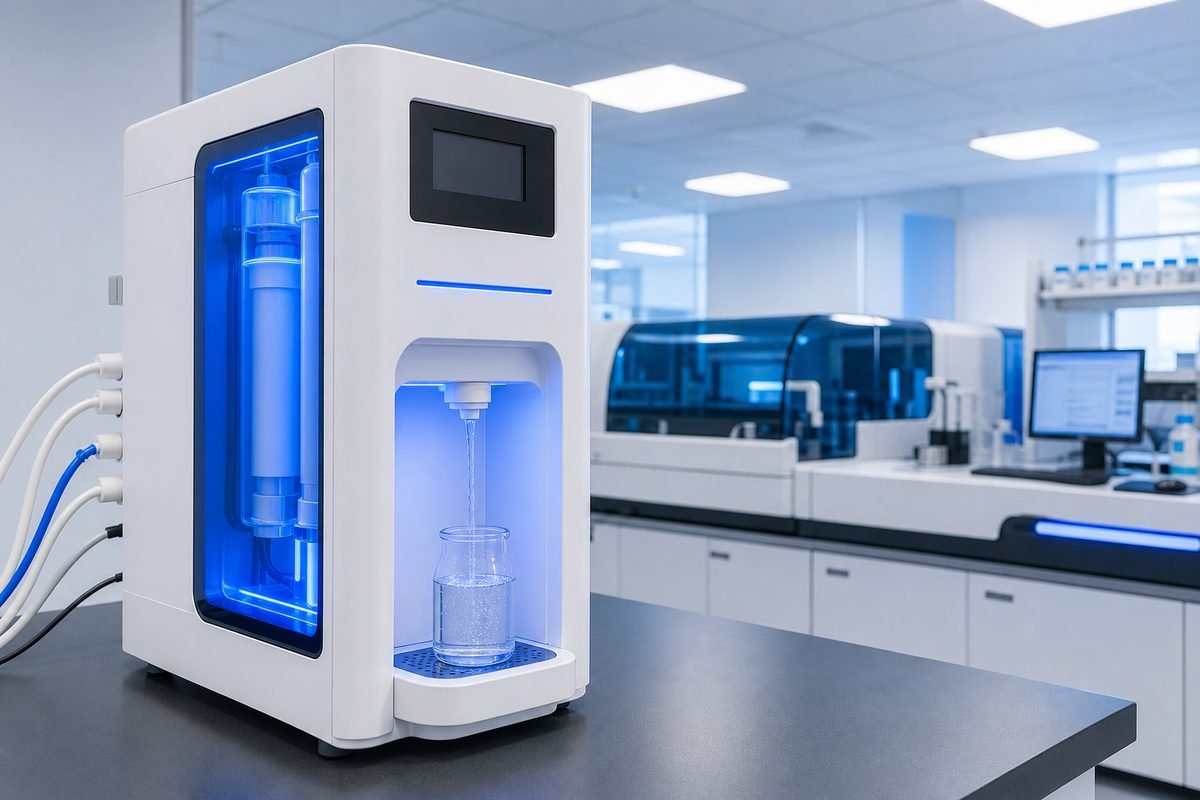
CSSD needs purified water for the final rinse and for steam generation. Hard water leaves spotting on instruments and scales the autoclave chamber; chloride carryover pits stainless steel. RO with DI polishing, held under 10 microsiemens, covers it.
Laboratory water splits by instrument. Washer-disinfectors and incubators run on Type III. Clinical chemistry and haematology analysers want Type II. Molecular work, HPLC and ICP-MS want Type I at 18.2 megohm-cm with low TOC and a point-of-use ultrafilter. We size the central RO to feed a bank of polishers rather than install a separate unit per analyser. See our note on water quality testing for clinics in Oman for the testing side.
Monitoring and validation
| Test | Frequency |
|---|---|
| Chloramine at carbon midpoint | Before every dialysis shift |
| Product conductivity and rejection | Continuous, logged |
| Total viable count, dialysis loop | Monthly, rotating sample points |
| Endotoxin, dialysis loop | Monthly |
| Full ISO 23500-3 chemical panel | Every 6 to 12 months, external lab |
| Loop disinfection | Quarterly, or on an action-level result |
| Softener hardness check | Weekly |
Every reading goes in a log the infection control committee can read. Validation is a record over time, not a certificate on the wall.
Where hospital systems fail
- Single carbon bed. No midpoint sample point means chloramine breakthrough is discovered from a patient reaction, not a test.
- Oversized storage on the dialysis loop. Water sitting in a large tank grows bacteria. Dialysis loops want small volume and constant movement.
- Dead legs from decommissioned machines. A capped spur stays capped and stays contaminated. Cut it back to the main.
- Softener ignored. Regeneration failures show up as membrane scaling months later.
- No redundancy. A single-pass RO on a dialysis unit means every service is a clinical decision.
- Sampling the same tap every month. Rotate points or the loop is never actually surveyed.
FAQ
Who supplies hospital water treatment in Oman?
UV Water Systems has delivered and maintains hospital water plant in Muscat including a 100 m3/day main line at Oman International Hospital with sand filter, multimedia, softener and a 500 LPH RO with DI unit, and the same specification at Women International Hospital in Muscat Hills.
Can a drinking water RO be used for dialysis?
No. A drinking water RO has no chloramine removal train, no loop recirculation, no sanitisation design and no monitoring regime. The membrane is the same component; everything around it is what makes the water safe for dialysis.
How often should the dialysis water loop be disinfected?
Quarterly as a baseline, and immediately on any action-level bacteria or endotoxin result. Heat sanitisation where the pipework allows it, chemical where it does not.
What does the carbon bed actually do?
It removes free chlorine and chloramine, which RO membranes do not reject and which cause haemolysis in dialysis patients. Two beds in series with a midpoint test is the standard arrangement precisely because the first bed exhausts without warning.
How long does a hospital RO installation take?
Four to twelve weeks from approved drawings, depending on plant room readiness, pipework runs and whether the unit has to stay in service during changeover. The survey is the step that sets the timeline, not the equipment lead time.
Do you handle AMC on hospital plant?
Yes, under ISO 9001:2015 procedures with monthly logged service reports. See RO plant AMC in Oman for what the contract covers.
Arrange a hospital plant survey
For hospital water treatment in Oman, from a dialysis loop design to a CSSD or laboratory water upgrade, call +968 9763 7786 or email sales@waterfilteroman.com.