RO Plant AMC in Oman: What the Best Service Contract Must Cover
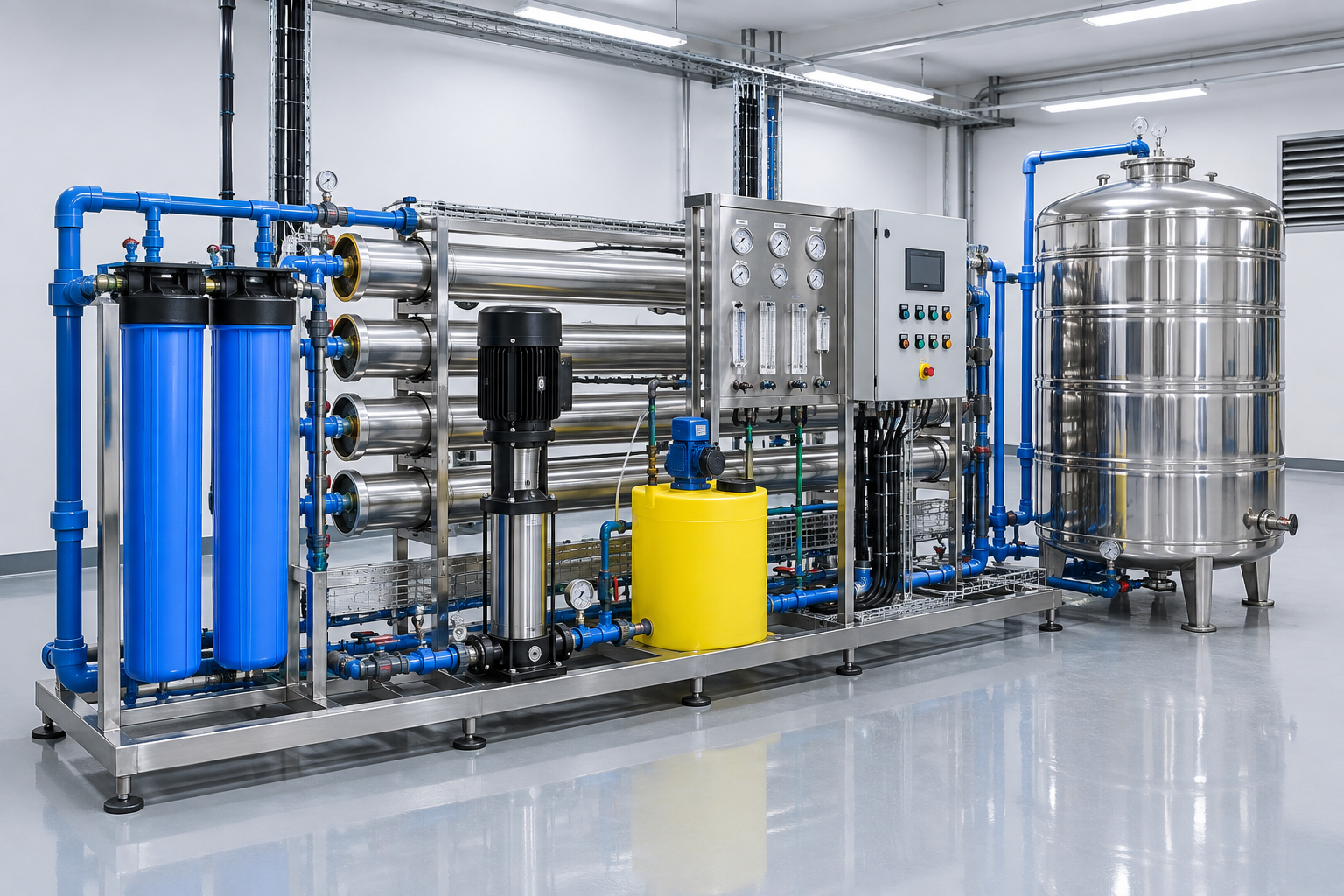
An RO plant AMC in Oman is the difference between a plant that still makes its rated output in year five and one that quietly drifts down to half capacity while the rejection creeps up. Membranes do not fail on a schedule. They fail from neglected pre-treatment, missed cartridge changes and dosing pumps nobody calibrated.
This page sets out what an RO plant AMC in Oman should actually cover, what it should cost against, how to compare two contracts that look identical on price, and the clauses worth arguing about before you sign.
On this page
- Why plants fail without a contract
- What the scope should include
- Visit frequency by plant size
- Comprehensive vs non-comprehensive
- How to compare two quotations
- Clauses to check before signing
- FAQ
Why plants fail without a contract
Across the plants we take over in Muscat, the same four causes account for nearly every premature membrane replacement:
- Pre-filters left past their life. A 5 micron cartridge at 20 psi differential is no longer protecting anything.
- Antiscalant dosing stopped weeks ago. The pump hums, the tank is empty, nobody checked. On Oman feed water the scale front moves fast.
- No CIP in two years. Fouling that a cleaning would have reversed becomes permanent.
- No baseline readings. Without normalised flow and rejection trends, you cannot see decline until the product tank runs short.
None of this is dramatic. That is the point. An RO plant AMC in Oman exists to catch the slow failures while they are still cheap.
Membrane manufacturers publish the operating limits every contract has to respect. The DuPont FilmTec technical manuals set the cleaning, flux and recovery limits, and the WHO guidelines for drinking-water quality set the product water targets. A good RO plant AMC in Oman is written against both, not against a generic template.
What the scope should include
A contract worth signing lists these items explicitly, not as “routine service”.
| Item | What it means |
|---|---|
| Scheduled preventive visits | Fixed frequency, with a signed service report each visit |
| Performance logging | Feed and product TDS, pressures, flows, recovery and rejection recorded per visit |
| Pre-filter and cartridge replacement | Stated quantity and interval, not “as required” |
| Media backwash and top-up | Sand, carbon and softener media checked, resin regeneration verified |
| Dosing system service | Pump calibration, stroke check, tank level, chemical supply named |
| Membrane CIP | Chemical cleaning at a stated interval or at a trigger value |
| Breakdown response | A response time in hours, with a named escalation contact |
| Water quality testing | Lab test frequency and the parameters covered |
| Spares list | What is included, what is chargeable, at what rate |
Every one of these lines appears in our own RO plant AMC in Oman contracts with a number against it. If any line reads “as required”, get it defined before signing. That phrase is where disputes start.
RO plant AMC in Oman: visit frequency by plant size
| Plant | Preventive visits | CIP |
|---|---|---|
| Under 500 LPH (office, cafe, clinic) | Quarterly | Annually or on trigger |
| 500 – 2,000 LPH (restaurant, school, small hotel) | Monthly | Every 6-12 months |
| 2,000 – 10,000 LPH (hotel, hospital, labour accommodation) | Monthly, with weekly chemistry checks | Every 4-6 months |
| Above 10,000 LPH or brackish feed | Fortnightly or resident operator | Every 3-4 months |
Brackish well feed shortens every interval. If your source is a well rather than mains, see well water treatment in Oman for why pre-treatment carries most of the load.
Comprehensive vs non-comprehensive
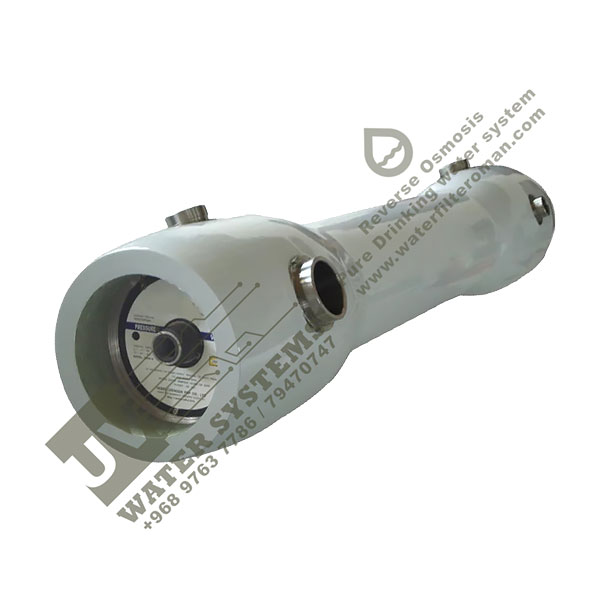
Non-comprehensive covers labour, visits and reporting. Consumables and spares are billed as used. Lower annual fee, variable total cost, and it suits a newer plant in good condition where you want to keep control of spend.
Comprehensive covers labour plus consumables, usually including cartridges, chemicals and sometimes membranes on a stated replacement cycle. Higher fixed fee, predictable budget, no argument about whose fault a cartridge was. It suits hospitals, hotels and government sites where downtime costs more than the premium, and where the budget has to be set a year ahead.
We quote both so the comparison is yours to make. For a plant past year four on brackish feed, comprehensive almost always ends up cheaper once membrane replacement is priced in.
How to compare two quotations
- Normalise visit count. Twelve visits against four is not the same contract at any price.
- Count the consumables. A low fee with everything chargeable is a deposit, not a price.
- Check who supplies chemicals. Antiscalant and CIP chemistry at your cost or theirs.
- Read the response time. “Prompt attention” is not a commitment. Hours are.
- Ask for the service report format. A contractor who logs normalised performance is managing the plant. One who ticks boxes is attending it.
- Confirm who holds membrane warranty. Dosing or cleaning outside spec can void it.
Clauses to check before signing
- Exclusions. Pump motors, pressure vessels, PLC boards and civil work are commonly excluded. Know which.
- Price escalation. Chemical and membrane prices move. A fixed-fee contract should say how renewal is priced.
- Water quality guarantee. Any output guarantee must be tied to a stated feed water envelope. If the feed changes, the guarantee cannot hold.
- Spare parts lead time. Imported membranes and dosing pumps are not same-day items in Oman.
- Handover of records. The service log belongs to you, not the contractor.
FAQ
How much does an RO plant AMC in Oman cost?
Annual fee is priced against plant capacity, visit frequency, feed water quality and whether consumables are included. A quarterly non-comprehensive contract on a small office plant sits at the low end; a monthly comprehensive contract on a hospital plant with membranes included sits at the high end. We quote per plant after a site survey because capacity alone does not predict workload.
How long do RO membranes last in Oman?
Three to five years on mains feed with working pre-treatment and dosing. Two to three years on brackish well feed. Under a year when antiscalant dosing has stopped, which is the case in most plants we are called to assess.
Can I keep my existing supplier’s plant under your AMC?
Yes. We service plants supplied by others. The first visit is a condition survey: performance baseline, pre-treatment check and a written list of what needs correcting before the contract starts.
What happens if the plant breaks down outside the visit schedule?
Breakdown attendance is part of the contract, within the response time stated in it. Parts are covered or chargeable depending on whether the contract is comprehensive.
Do I need an AMC on a plant still under warranty?
Usually yes, and often the warranty requires it. Supply warranty covers defects. It does not cover the servicing that keeps the warranty valid.
What records should I expect each visit?
A signed service report with feed and product TDS, operating pressures, flows, recovery, calculated rejection, work performed, parts fitted and any recommendation. Monthly for a managed plant, filed and trended.
Why an RO plant AMC in Oman pays for itself
A full membrane set on a 5,000 LPH plant costs several times the annual fee on a comprehensive contract. Add the cost of trucked-in water while the plant is down, and the arithmetic is not close. The plants that run cleanest in our portfolio are the ones where someone reads the service report each month and acts on the trend rather than filing it.
Get your plant assessed
UV Water Systems maintains RO plants across Oman for hospitals, hotels, oil sector sites, schools and government entities, under ISO 9001:2015 certified procedures. Call +968 9763 7786 or email sales@waterfilteroman.com for a condition survey and an AMC quotation.