Well Water Treatment in Oman: A 2026 Guide for Villas and Farms
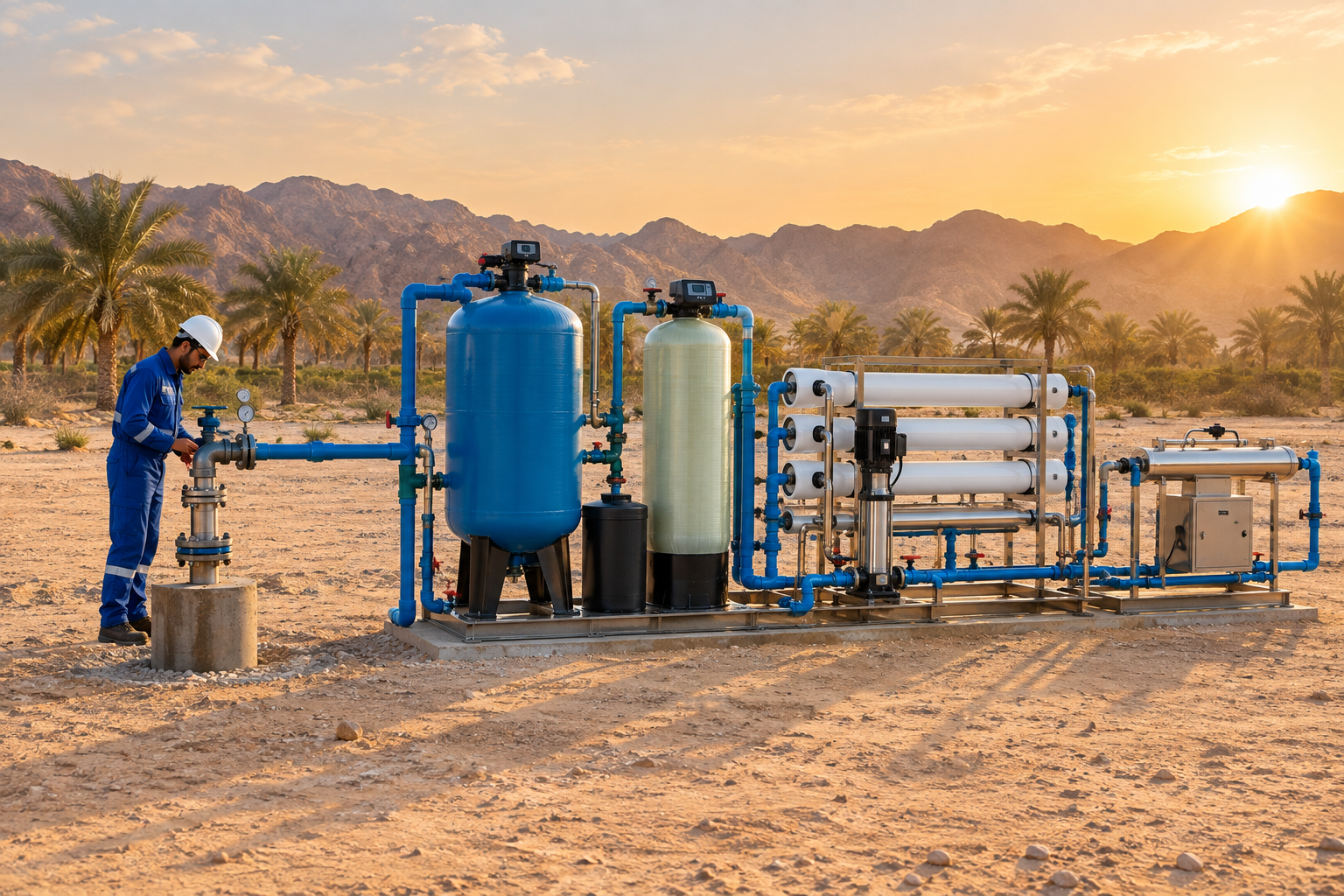
Plenty of villas and farms in Oman run on a borewell rather than mains supply, and almost all of them treat the well as if it were a tap. It is not. Well water in Oman carries salinity, iron, hardness and sometimes hydrogen sulphide, and the mix changes with rainfall, with pumping rate, and with how many neighbours are drawing from the same aquifer.
Well water treatment in Oman starts with a lab analysis, not with a system. Anyone who quotes you a plant before seeing your water numbers is guessing.
What is usually in an Omani borewell
Across the areas we work in, from Barka and Nakhal through Quriyat and out to Ibri and Salalah, the same handful of problems come up.
| Problem | How you notice it | Typical treatment |
|---|---|---|
| High salinity (TDS 1,500 to 8,000 ppm) | Salty taste, crops stunted, appliances corroding | Brackish water RO |
| Hardness (300 to 1,200 ppm) | Scale in pipes, heaters, irrigation lines | Softener, or antiscalant ahead of RO |
| Iron and manganese | Brown or black staining on sinks and laundry | Oxidation plus manganese greensand or birm |
| Hydrogen sulphide | Rotten egg smell | Aeration or oxidation plus carbon |
| Sand and silt | Blocked nozzles, worn pump seals | Sand filter or multimedia filter |
| Bacteria | Nothing visible; shows on a lab test | UV steriliser or chlorination |
Salinity is the one that decides the budget. Below roughly 1,000 ppm TDS you can often get away with filtration and softening. Above that, for drinking water you need reverse osmosis, and the higher the TDS the more the plant costs to build and to run.
Well water treatment in Oman starts with the analysis
Pump the well for at least 30 minutes before you take the sample, otherwise you are testing stagnant water in the casing rather than the aquifer. Ask the lab for TDS, conductivity, pH, total hardness, calcium, magnesium, sodium, chloride, sulphate, iron, manganese, silica, and total coliform. Silica matters more than people expect: above about 120 ppm it limits how hard you can push an RO system before scaling the membranes.
Repeat the test after the rains. A well that reads 2,000 ppm in March can read 4,000 ppm in September, and a plant designed for the good number will fail on the bad one. Use the WHO drinking water quality guidelines as the benchmark for potable limits, alongside Oman Standard OS 8 for bottled and drinking water.
Designing the well water treatment train
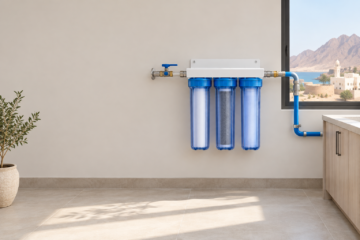
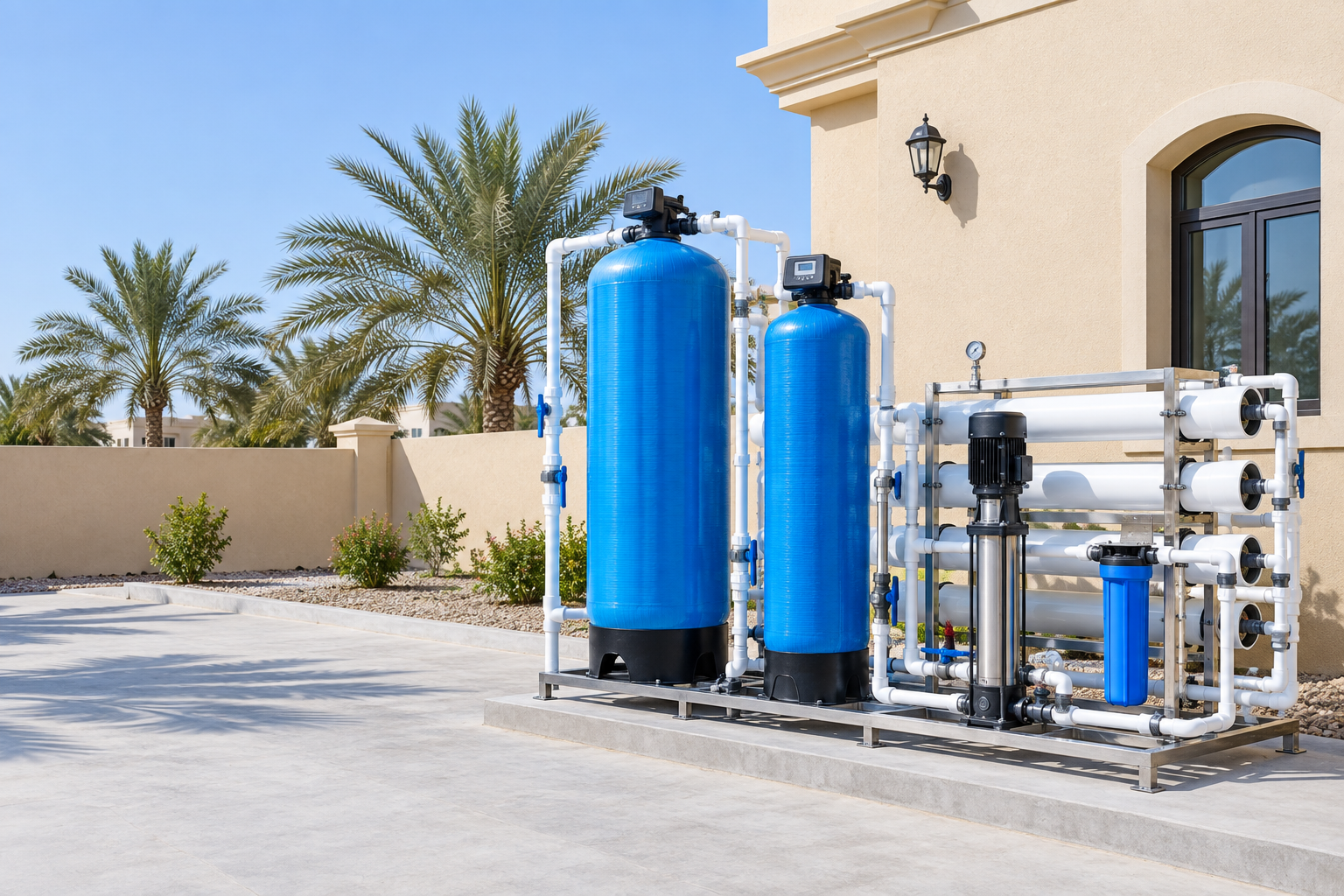
For a villa on a moderately saline well, the sequence is usually:
- Raw water tank with a float, so the pump is not cycling against the plant.
- Sand or multimedia filter to take out silt and suspended solids.
- Iron removal if iron is above 0.3 ppm. This has to come before the softener or it fouls the resin.
- Softener to protect the membranes, or antiscalant dosing as the cheaper alternative on larger systems.
- 5 micron cartridge as membrane protection.
- Brackish water RO sized to actual daily drinking and cooking demand, not to the whole house.
- UV steriliser on the treated line.
- Treated water tank and a separate distribution loop.
The point most people miss: you rarely treat the whole house with RO. Run RO for drinking and kitchen, and filtered plus softened water for bathrooms, laundry and irrigation. Treating 100% of a villa’s consumption to drinking standard triples the plant size and wastes reject water you could be using on the garden anyway.
The sizing logic is the same one we describe for larger systems in our industrial RO plant sizing guide.
Well water treatment in Oman on farms: a different problem
On a farm the question is not potability, it is what the crop and the soil will tolerate. Two numbers drive irrigation decisions: electrical conductivity, and the sodium adsorption ratio. High SAR water degrades soil structure over seasons even when the crop looks fine in year one. Date palms handle salinity far better than vegetables or greenhouse crops, so the right answer is often partial treatment: blend RO permeate back with raw water to hit a target EC rather than desalinating everything.
Reject water is the other farm-specific issue. A brackish RO recovering 50 to 65% leaves you a concentrated stream that cannot simply go onto the field. Plan the disposal or the evaporation pond at design stage, not after commissioning.
What well water treatment in Oman costs to run, not just to buy
Purchase price is the smaller half of the decision. A well water plant has four recurring costs: membrane replacement every 2 to 4 years depending on how well the pre-treatment does its job, cartridge and media changes, antiscalant or salt, and electricity for the high pressure pump. A plant with weak pre-treatment is cheaper on day one and considerably more expensive by year three, because the membranes are the expensive part and pre-treatment is what protects them.
Our cost guide by system type gives the price bands for the common configurations.
Five well water treatment in Oman mistakes we are called out to fix
- No raw water tank. The RO runs straight off the borehole pump, pressure swings, and the membranes take the abuse.
- Softener before iron removal. The resin fouls within months and never recovers.
- A plant sized on one water test. Seasonal variation was never measured.
- Standard seawater membranes on brackish water. Wrong membrane, wrong pressure, high running cost.
- No hardness or TDS monitoring. Nobody knows the plant is failing until the taste changes.
Getting well water treatment in Oman specified properly
UV Water Systems designs and installs well water treatment for villas, farms and remote sites across Oman, from a few hundred litres a day up to full commercial plants. We start with a water analysis, size the plant against your real demand and your real feed water, and put the system on a service schedule so the membranes last.
Send us a recent water analysis, or ask us to collect a sample, and we will come back with a treatment train and a price.
We assure the quote is in line with your requirement.
In case of any additional info please feel free to contact the undersigned.
Thanks & Regards
Fasalu Rahman
Product Specialist | Water Treatment Division
ISO 9001:2015 Quality Certified
Uniqueness View LLC | Muscat, Sultanate of Oman
M: +968 9763 7786
W: www.uvwater.biz
Well water treatment in Oman: common questions
How much does well water treatment in Oman cost?
A villa system on moderately saline water usually lands between 400 and 1,200 OMR installed, depending on flow rate and whether a softener and brackish RO are both needed. Farm and industrial plants are priced per m3/day after the analysis.
Can I drink borewell water after filtration?
Only after RO plus UV, and only once a lab test confirms it. Sediment and carbon filters alone remove turbidity and chlorine taste, not salinity, nitrate or bacteria.
How often should the water be retested?
Twice a year for a villa, quarterly for a farm. Aquifer chemistry moves with rainfall and with pumping across the area, and a treatment train sized for last year’s numbers will drift out of spec.
Who handles well water treatment in Oman?
UV Water Systems designs, supplies and maintains well water treatment in Oman for villas, farms and industrial sites, from the water analysis through commissioning and the annual service contract.