Industrial RO Plant Oman: Best 2026 Guide to Sizing and Design

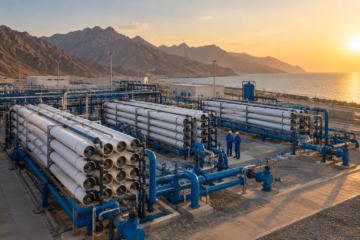
An industrial RO plant Oman factories install is a process unit, not an appliance. It has a design basis, an operating window and a failure mode, and every one of those is set on paper before a single vessel arrives on site. When a plant underperforms in year two, the cause is almost always a design decision made in week one that nobody wrote down.
We design, install and maintain these systems for oil and gas facilities, hospitals, food production and hotel groups around Muscat. What follows is the order we work in, and the questions worth putting to any supplier before you sign.
Start with a full feed water analysis
Every industrial RO plant Oman sites operate is designed backwards from the feed. A TDS number alone is not enough. The analysis needs to cover hardness as calcium and magnesium, alkalinity, chloride, sulphate, silica, iron, manganese, turbidity, SDI and temperature.
Silica and iron matter more than most buyers expect. Silica sets a hard ceiling on recovery rate, and iron above a fraction of a milligram per litre will foul membranes regardless of how good the antiscalant is. Temperature matters too: warmer feed passes more water through the membrane, so a plant sized on a January sample will look oversized in August and the reverse if you get it backwards.
Set capacity, recovery and array before pricing
Three numbers define the plant:
- Permeate capacity in m³/day or LPH, based on peak process demand plus a margin, not on average daily use.
- Recovery rate, the percentage of feed that becomes product. Typically 50–75% depending on what the feed chemistry supports. Pushing recovery beyond the scaling limit is the single most common design fault.
- Array configuration, for example 2:1 or 3:2, which sets the crossflow velocity through each stage and controls how evenly the membranes foul.
Ask for the projection printout. Any competent supplier runs the design through membrane projection software and can hand you the output showing flux, recovery, concentrate concentration and scaling indices at your feed conditions. If they cannot produce it, the plant was picked from a catalogue.
Pretreatment carries the whole system
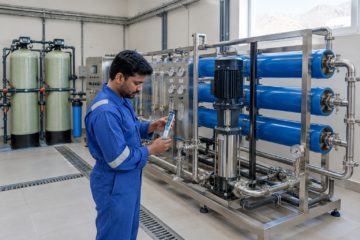
The membranes are the expensive part. Pretreatment is what protects them, and the cost of getting it right is small next to a full element replacement. A typical train for an industrial RO plant Oman conditions demand runs:
- Multimedia or sand filtration for turbidity and suspended solids, sized on filtration velocity with automatic backwash.
- Softening or antiscalant dosing to hold hardness in solution through the concentrate stream.
- Activated carbon or sodium metabisulphite dosing to strip free chlorine, which oxidises polyamide membranes within hours.
- Cartridge filtration at 5 micron as the final guard ahead of the high-pressure pump.
Where the process needs water purer than RO alone delivers, the plant continues into ion exchange. Our guide to a DM plant for laboratories in Oman covers that stage and how the two technologies divide the work.
Instrumentation is not an optional extra
The difference between a plant that fails safely and one that destroys itself is a handful of inexpensive instruments:
- Low-pressure switch on the pump suction to prevent dry running
- High-pressure switch on the discharge
- Inline conductivity on the permeate with an alarm and a divert valve
- Pressure gauges before and after every stage, so differential pressure trends are visible
- Flow meters on permeate and concentrate, because recovery cannot be verified without both
- Hour run meter on the pump
Log those readings weekly. Normalised flux and salt passage trends will tell you a membrane is fouling weeks before anyone notices a problem at the point of use.
Cleaning, energy and running cost
Build the CIP skid into the original scope. Retrofitting clean-in-place onto an industrial RO plant Oman operators already run means downtime and awkward pipework. Plan for alkaline cleaning for organics and biofilm, acid cleaning for scale, and a written trigger point: typically a 10–15% drop in normalised permeate flow or a 15% rise in differential pressure.
On energy, the high-pressure pump dominates the bill. We specify Grundfos units and, on larger plants, a variable frequency drive so the pump follows demand rather than throttling against a valve. General water quality context is set out in the WHO drinking water quality guidelines.
Frequently asked questions
How long do industrial membranes last?
Three to five years with correct pretreatment and a cleaning regime that is actually followed. Without pretreatment, twelve months or less.
What documentation should handover include?
A testing and commissioning report with feed and permeate TDS, flows, pressures and recovery; the membrane projection; a P&ID; an operation manual; and operator training signed off. That package is your baseline for every future performance dispute.
Do you handle tenders and prequalification?
We are ISO 9001:2015 certified and registered with the Oman Tender Board and JSRS for the oil and gas sector.
Get a design, not a catalogue number
Send us your feed water analysis and process demand, and we will return a sized industrial RO plant Oman design with the projection attached and every exclusion stated in writing. See our commercial RO plant guide, all water treatment services, or contact us on +968 9763 7786.
Industrial water treatment guides
Related stages in the same treatment train.