DM Plant Oman: 5 Design Points for Safe Laboratory Water
A DM plant Oman laboratories install is judged on one number: outlet conductivity. Everything else in the specification exists to hold that number steady, day after day, while the feed water changes underneath it. Get the design right and the plant runs quietly for years. Get it wrong and your analysts start blaming their reagents.
We have built and maintained demineralisation systems for hospital laboratories, oil and gas testing facilities and university labs around Muscat. These five points decide whether the plant meets its specification in year three, not just on commissioning day.
1. Decide the water grade before anything else
“Demineralised water” is not a specification. Laboratory water is graded, and the grade drives the entire design of a DM plant Oman facilities put out to tender.
- Type III: Roughly 0.05–1.0 µS/cm. Glassware washing, autoclaves, water baths. RO plus a polishing resin bed handles this.
- Type II: Below about 1.0 µS/cm with low organics. General analytical work, buffer preparation, media.
- Type I: 18.2 MΩ·cm at 25 °C. HPLC, ICP-MS, molecular biology. Needs mixed-bed polishing at the point of use, plus UV and a final 0.2 micron filter.
Specifying Type I where Type III is enough triples the cost and the consumable bill. Specifying Type III where Type I is needed will show up as baseline noise on an instrument, and nobody will connect it to the water for months.
2. Pretreatment carries the DM plant Oman design
Ion exchange resin is a consumable. Every milligram of hardness, chlorine or organic matter that reaches it shortens the run between regenerations. Pretreatment is what keeps operating cost down.
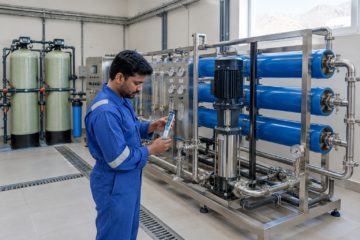
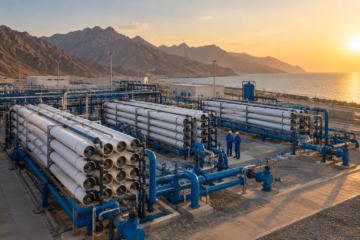
A sound train ahead of the DM stage is a multimedia filter, a softener, activated carbon for chlorine, and RO as the bulk demineralisation step. RO does 95–99% of the work at a fraction of the cost of resin. The resin then polishes what is left. Any DM plant Oman quotation that puts resin directly on raw municipal or tanker water is designed to sell you regenerations.
3. Two-bed or mixed-bed, and why it matters
Two-bed systems run a strong acid cation vessel followed by a strong base anion vessel. They handle high loads economically and are regenerated on site with acid and caustic. That means chemical storage, a bund, trained handling and a neutralisation pit.
Mixed-bed systems blend both resins in one vessel and reach much lower conductivity, but exhaust faster. Most laboratories are better served by exchangeable mixed-bed cartridges swapped on a service visit, which removes chemical handling from the building entirely. For a laboratory-scale DM plant Oman sites usually land on RO plus service-exchange mixed bed.
4. Continuous conductivity monitoring with an alarm
An inline conductivity or resistivity meter at the outlet, with temperature compensation and a configurable alarm setpoint, is not an optional extra. It is the only thing standing between exhausted resin and a batch of invalid results.
Specify a display at the point of use, an alarm relay, and a logged output if the lab is accredited. ISO 17025 audits ask how you demonstrate water quality on the day of the test, and a wall meter with no record is a weak answer.
5. Storage, loop design and bacteria
High-purity water is aggressive and biologically vulnerable at the same time. It picks up ions from unsuitable pipework and supports growth wherever it sits still.
- Use PVDF, PP or 316L stainless for distribution, never galvanised or copper.
- Design a recirculating loop with no dead legs. Any branch longer than a few pipe diameters becomes a growth site.
- Fit a vent filter on the storage tank so the tank does not breathe dust and CO₂ back in.
- Add UV at 254 nm on the loop, and a 0.2 micron final filter at the point of use for Type I.
Guidance on treatment and distribution principles is set out in the WHO drinking water quality guidelines, which remain a useful baseline even for laboratory systems.
Frequently asked questions
How is a DM plant different from an RO system?
RO pushes water through a membrane and removes most dissolved solids. Demineralisation uses ion exchange resin to remove the remaining ions almost completely. Most laboratory installations use both, in that order.
How often does the resin need changing?
It depends entirely on feed quality and consumption. With RO ahead of it, a service-exchange mixed bed in a typical lab runs several months. Without RO, weeks.
Do you provide commissioning documentation?
Yes. Every plant we hand over comes with a testing and commissioning report covering feed and product conductivity, flow rates and pressures, plus an operation manual and operator training.
Talk to us about your laboratory
Tell us the water grade you need, your peak litres per hour and your instrument list. We will size a DM plant Oman laboratories can validate against, and quote it line by line with exclusions stated. See our water treatment services, read about water quality testing, or contact us on +968 9763 7786.
Related reading
Related guides on commercial systems and consumable schedules.
Industrial water treatment guides
The DM stage sits inside a wider treatment train. These cover the rest of it.