Chemical Dosing System Oman: 6 Rules to Avoid Costly Errors
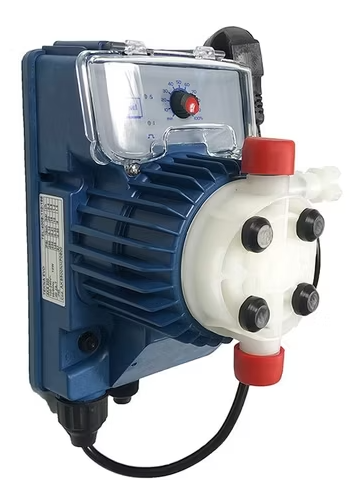
A chemical dosing system Oman plants install is small, cheap relative to the equipment it protects, and responsible for more expensive failures than almost anything else on site. An antiscalant pump that has been running dry for three weeks does not announce itself. You find out when the membranes come out scaled.
Six rules cover most of what goes wrong with a chemical dosing system Oman sites run. We apply them on every installation, from a single antiscalant pump on a small RO skid to multi-stream dosing on an industrial plant.
1. Size the pump on turndown, not maximum flow
The usual mistake is picking a pump whose maximum output matches peak dose. That pump then runs at 4% stroke for normal operation, where metering accuracy collapses and the check valves stop seating reliably.
Size a chemical dosing system Oman conditions will run every day so that normal duty sits between 30% and 70% of pump capacity. That leaves headroom for peak demand and keeps the pump in the range where its stated accuracy actually applies. Where the flow range is genuinely wide, use a flow-proportional pump driven by a pulse signal from the water meter rather than a fixed-stroke unit.
2. Match materials to the chemical, every wetted part
Sodium hypochlorite, hydrochloric acid, caustic soda and antiscalant are four different chemical environments. The pump head, diaphragm, valve seats, tubing, injection quill and calibration column all need to suit the chemical in the tank.
- Hypochlorite off-gasses and airlocks pumps. It needs a degassing head or a self-priming arrangement.
- Acid attacks the wrong elastomers quickly. Check the diaphragm and O-ring specification, not just the pump body.
- Antiscalant is generally benign but thickens in cold conditions and can crystallise around a poorly placed injection point.
We use Emec Italy and SEKO pumps for this reason: the wetted-material options are properly documented and the spares are available in Oman.
3. Fit a calibration column and use it
A dial setting is not a dose rate. The only way to know what a pump is delivering is to draw from a graduated calibration column and time it. Any chemical dosing system Oman auditors will look at should have a column plumbed in with isolation valves, and a log showing it has been used.
Calibrate at commissioning, after any chemical change, and at every service visit. Pump output drifts as the diaphragm ages, and the drift is downward.
4. Design the suction side properly
Most dosing faults are suction faults. Get these right and the pump largely looks after itself:
- Foot valve with a strainer sitting just above the tank floor, never resting on it.
- Flooded suction where possible, with the pump mounted at or below tank liquid level.
- Low-level switch wired to stop the pump and raise an alarm. This one component prevents the failure described at the top of this article.
- Short, rigid suction line with no high points where gas can collect.
- Back-pressure valve on the discharge where the injection point has little resistance, to stop siphoning.
5. Containment, ventilation and separation
Every chemical tank needs a bund sized to hold the full tank contents. Acid and hypochlorite must be bunded separately, because mixing the two releases chlorine gas. That is not a theoretical risk; it is the most common serious incident in small water treatment plant rooms.
Add ventilation, an eyewash station and safety shower within reach, correct labelling on tank and line, and the safety data sheet posted in the room. Operators need PPE stored at the point of use, not in an office. Guidance on treatment chemicals and residual limits is set out in the WHO drinking water quality guidelines.
6. Close the loop with monitoring
Open-loop chemical dosing system Oman installations assume nothing changes. Something always changes. Where the dose matters, measure the result and feed it back: an ORP or free-chlorine analyser on disinfection, a pH controller on neutralisation, a conductivity meter downstream of the treatment step.
On an RO installation, the practical minimum is a low-level switch, a calibration log and a weekly check of the concentrate for scaling indicators. Our guides to the industrial RO plant in Oman and the DM plant for laboratories in Oman cover where dosing sits in each train.
Frequently asked questions
Why does my dosing pump lose prime?
Usually gas in the suction line, a worn foot valve, or hypochlorite off-gassing in a standard pump head. Check the suction route for high points first.
How often should the diaphragm be replaced?
Annually on continuous duty is a sensible default, sooner on aggressive chemicals. Replace valve cartridges at the same time.
Can you retrofit dosing to an existing plant?
Yes, and it is common. The work is usually the tank, bund and injection point rather than the pump itself.
Specify it properly the first time
Tell us the chemical, the dose rate and the water flow range, and we will specify a chemical dosing system Oman plant rooms can pass an audit with, quoted line by line with exclusions stated. See all water treatment services, browse the store, or contact us on +968 9763 7786.
Industrial water treatment guides
Where dosing fits in the wider system.