Commercial RO Plant Oman: 7 Checks to Avoid a Costly Mistake
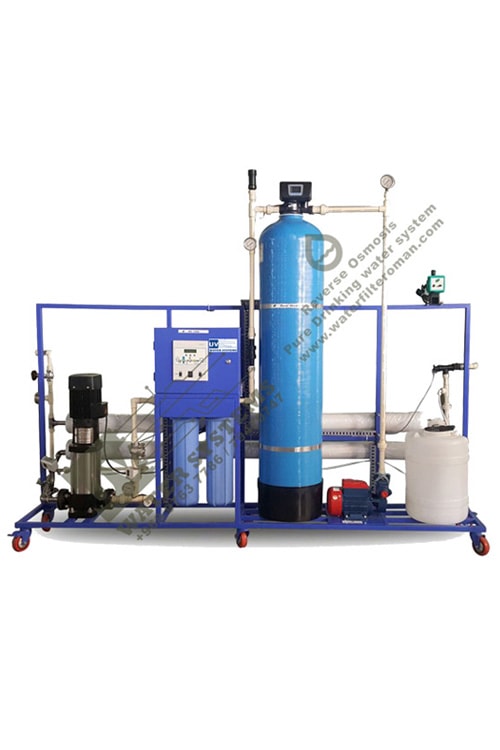
A commercial RO plant Oman businesses buy on price alone tends to fail in the second summer. Not dramatically. It just starts producing less water, the TDS at the outlet creeps up, and one morning the coffee machine downstream is scaling again. By then the supplier has moved on and nobody has the original design calculation.
We have commissioned and serviced these systems in hospitals, oil company stations, hotel kitchens and laboratories across Muscat. The plants that are still running well after five years all got the same seven things right at purchase. Here they are, in the order they matter.
1. Feed water analysis before anything else
No honest commercial RO plant Oman quotation can be written without a feed water report. Hardness, TDS, chloride, iron, silica and SDI all change the design. Muscat municipal supply, a private tanker, and a borehole in Barka are three completely different feed waters, and a membrane sized for one will foul on another.
If a supplier quotes you a plant without asking for a water sample, they are selling you a catalogue item and hoping.
2. Capacity sized on peak demand, not daily average
Restaurants and cafes do not draw water evenly. A café pulling 2,000 litres a day might draw a third of it between 7 and 10 AM. Size on the average and the storage tank empties at breakfast.
The right approach is production capacity plus buffer storage, with the plant refilling during quiet hours. For a commercial RO plant Oman kitchens depend on, we usually specify a stainless or food-grade tank sized to cover the busiest three-hour window on its own.
3. Pretreatment that matches the feed
Membranes are expensive. Pretreatment is what protects them. A typical train looks like this:
- Sand or multimedia filter for suspended solids and turbidity
- Softener to strip hardness before it precipitates on the membrane surface
- Carbon filter to remove chlorine, which destroys polyamide membranes quickly
- Antiscalant dosing where hardness or silica is high, using a metered dosing pump
- 5-micron cartridge as the final guard before the high-pressure pump
Skipping the carbon stage is the most common shortcut we find on cheap imports, and it is the one that kills membranes fastest.
4. Membrane brand and the recovery rate
We specify Dupont Filmtec membranes because the performance data is published, the elements are available in Oman, and replacements fit without modifying the housing. Generic membranes save money once and cost money every year after.
Ask for the design recovery rate. A commercial RO plant Oman sites run at 50–75% recovery depending on feed quality. A plant pushed to a higher recovery than the feed supports will scale, no matter whose membrane is inside.
5. Pump, pressure vessel and control quality
The high-pressure pump runs for hours a day, every day. We use Grundfos for this reason. On the control side, look for a low-pressure switch, a high-pressure switch, a tank level switch and a conductivity meter with an alarm. Those four items cost little and prevent the two failures that actually strand a business: a dry-run pump burnout and undetected poor water quality.
6. Service access and spare parts in country
A plant is only as good as the response time when it stops. Before signing, ask where the membranes, cartridges and dosing spares are stocked. If the answer is “we order from China”, plan for two to six weeks of downtime per incident.
An annual maintenance contract on a commercial RO plant Oman operators rely on typically covers quarterly cartridge changes, membrane cleaning, dosing calibration and a written water quality report. Our filter service and AMC options follow the same structure.
7. Commissioning report and warranty in writing
You should receive a testing and commissioning report showing feed TDS, product TDS, flow rates, pressures and recovery on day one. That document is your baseline. Without it, nobody can prove later whether performance dropped.
Warranty should be stated separately for the plant, the pump and the membranes, because they are never the same duration. General guidance on treatment processes is available from the World Health Organization drinking water guidelines if you want to read further.
Frequently asked questions
What size plant does a restaurant need?
It depends on covers per day, whether you run ice machines and coffee equipment, and whether kitchen washing is on the same line. A 250–500 LPH plant covers most single-branch restaurants in Muscat. Larger hospitality kitchens move to 1000 LPH and above.
How often do membranes need replacing?
With correct pretreatment and regular cleaning, three to five years is normal. Without pretreatment, one year or less.
Do you handle installation and civil work?
We handle mechanical installation, piping, commissioning and training. Civil work such as plinths and drainage is quoted separately and listed clearly as not included.
Get a plant designed for your site
Send us your water report, or we will collect a sample. You get a line-by-line proposal with the design basis attached, so you can see exactly what a commercial RO plant Oman quotation should contain. See our water treatment services, browse the online store, or contact us on +968 9763 7786.
Related reading
Related guides on industrial and pretreatment equipment.
Industrial water treatment guides
For larger process and utility applications, these go further.