Solar Panel Cleaning Water: Best RO & DI Guide for Oman 2026
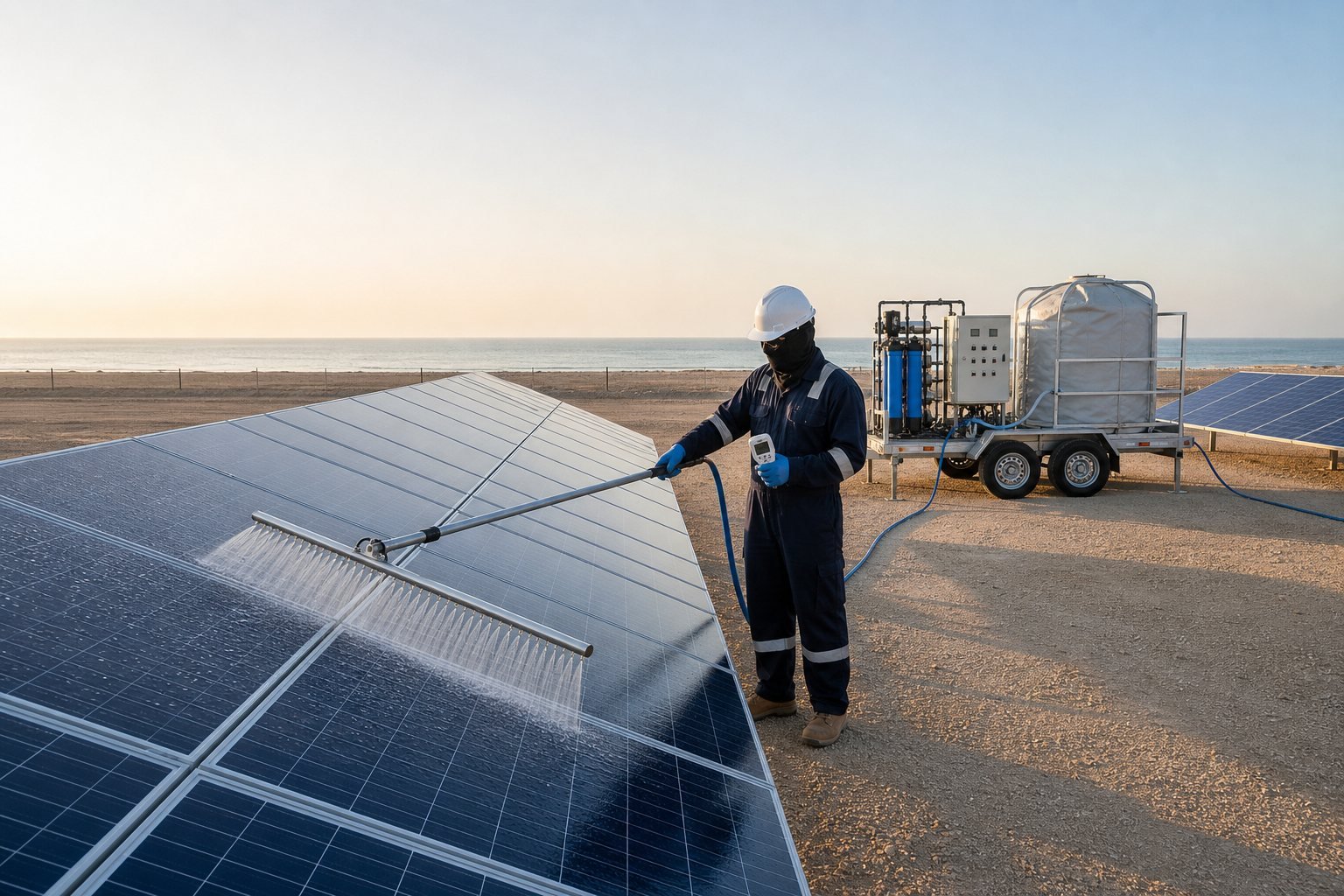
The solar panel cleaning water you spray onto a module decides whether the wash gains you output or slowly destroys the glass. Water evaporates in minutes on an Omani array; every mineral it carried stays behind, baked onto the anti-reflective coating. That is why a PV cleaning contract in Oman is really a water treatment specification, and why the filtration skid matters more than the brush.
What solar panel cleaning water has to do
A PV module is a sheet of low-iron glass with a thin anti-reflective coating on top. The coating is what buys you the last few percent of output, and it is the part that damages first. Wash water has three jobs: lift the dust, carry it off the glass, and leave nothing behind when it dries. The first two are the brush and the flow rate. The third is entirely down to water chemistry.
Two failures show up on Omani sites when the solar panel cleaning water is not treated. Calcium and magnesium dry into a white scale film that scatters light and needs acid to remove. Silica, which nobody tests for, dries into a glass-like layer that bonds to the coating and cannot be removed at all without stripping the AR layer with it. The second failure is permanent, and most module warranties exclude it.
What Oman’s feed water does to PV glass
Solar sites in Oman rarely sit next to a source that can be used as solar panel cleaning water without treatment. Ibri, Manah, Adam and the Duqm corridor draw on borewells or tankered supply, and the chemistry is nothing like Muscat mains. Typical figures we see on site:
| Source | TDS (ppm) | Hardness (as CaCO3) | Silica | Verdict for washing |
|---|---|---|---|---|
| Muscat desalinated mains | 150 – 400 | 40 – 120 | 2 – 8 ppm | Leaves visible spotting |
| Interior borewell (Adam, Nizwa, Ibri) | 1,500 – 6,000 | 400 – 1,500 | 15 – 40 ppm | Scale plus silica bonding |
| Tankered mixed supply | 500 – 2,500 | 150 – 700 | 5 – 25 ppm | Unpredictable, still damaging |
| Treated solar panel cleaning water | under 10 | under 1 | under 1 ppm | Dries spot-free, no residue |
Soiling itself is the reason anyone washes at all. In Gulf desert conditions an unwashed array loses roughly 0.3% to 1.0% of output for every day of dust accumulation, and a season of neglect can take double-digit percentages off annual yield. Oman is building toward 30% renewable electricity by 2030 across Ibri, Manah and the wind and solar projects behind it, according to Times of Oman’s coverage of the national programme, so the cleaning volume in this country only goes one way.
Target specification for solar panel cleaning water
There is no Omani standard written specifically for solar panel cleaning water, so we design against module manufacturer guidance and the practical spot-free threshold used across the industry.
| Parameter | Target | Why |
|---|---|---|
| TDS | Under 10 ppm; under 5 ppm preferred | Below this, evaporation leaves no visible residue |
| Conductivity | Under 20 µS/cm | The number your operator can actually read on a meter |
| Total hardness | Under 1 ppm as CaCO3 | Prevents carbonate scale film |
| Reactive silica | Under 1 ppm | Silica film is not removable once baked on |
| Chloride | Under 5 ppm | Protects frame, clamps and junction box seals |
| pH | 6.0 – 8.0 | Outside this range the AR coating and sealants suffer |
| Turbidity | Under 1 NTU | Suspended grit under a brush scratches glass |
Write these numbers into the O&M contract. A cleaning subcontractor who is paid per module has no reason to buy resin when tanker water is cheaper, unless the specification and the TDS log say otherwise.
How a solar panel cleaning water system is built
The train below is what we install for PV sites. Every stage exists because of something the previous stage cannot handle.
- Raw water tank and feed pump. Buffers tanker deliveries and gives the plant a steady suction head. Size it for at least one full wash cycle plus a day.
- Multimedia or sand filter. Drops turbidity and SDI so the membranes see clean water. Borewell feed in the interior is often loaded with fine sand that would shred a cartridge in days.
- Antiscalant dosing. An EMEC metering pump injecting antiscalant ahead of the membranes. On high-hardness, high-silica borewell feed this is what keeps recovery up and CIP intervals long.
- Activated carbon or metabisulphite dosing. Only where the feed is chlorinated. Free chlorine oxidises polyamide membranes and the damage is not reversible.
- 5 micron cartridge filter. The last mechanical guard before the high pressure pump.
- RO unit. Grundfos high pressure pump feeding Filmtec brackish water membranes. This is the stage that removes 96% to 99% of the dissolved load and does the heavy lifting on cost.
- Permeate tank. Stores RO product and decouples production rate from wash rate, which is what lets a modest plant serve a large array.
- Mixed bed DI polisher. Takes RO permeate from roughly 20 ppm down to under 1 ppm. This is the stage that makes the water genuinely spot-free.
- Delivery pump, hose reel and brush or robot feed. Sized to the wash method, with an inline TDS meter the operator can see.
The inline TDS meter is not a luxury. It is the only thing that tells a crew at 5 am that the resin is exhausted before they spray 2,000 modules with hard water.
RO, DI, or both: why DI alone gets expensive
Small contractors often start with a portable DI vessel alone, because it is cheap to buy. On Omani feed water it is the most expensive way to produce solar panel cleaning water, and the arithmetic is easy to check.
A working rule of thumb: one litre of mixed bed resin will polish roughly 100,000 ppm-litres of water. In other words, one litre of resin treats about 1,000 litres of 100 ppm water, or 100 litres of 1,000 ppm water. Rearranged:
Resin required (litres) = volume to treat (litres) × feed TDS (ppm) ÷ 100,000
| Feed water | Feed TDS | Resin per 3,000 L wash | Practical outcome |
|---|---|---|---|
| RO permeate | 20 ppm | 0.6 litres | One small polisher lasts weeks |
| Muscat mains, no RO | 350 ppm | 10.5 litres | Resin change every few washes |
| Interior borewell, no RO | 2,500 ppm | 75 litres | Resin cost exceeds the cleaning fee |
That table is the whole argument. RO removes the bulk load at a few hundred baisa per cubic metre in energy and consumables; resin removes the last traces at a far higher unit cost. Use each stage for the job it is cheap at. DI-only makes sense for one case in Oman: a small rooftop portfolio in Muscat washing a few hundred modules a month on low-TDS mains, where a portable vessel in the back of a pickup beats a skid.
Sizing a solar panel cleaning water plant
Solar panel cleaning water consumption depends on method, not panel count alone. A rotating brush with a low-flow rinse uses a fraction of what an open spray-only wash uses.
| Method | Water per module | Per 1 MW (approx. 1,800 modules) |
|---|---|---|
| Brush plus DI rinse | 0.4 – 0.8 litres | 0.7 – 1.4 m³ |
| Spray rinse only | 1.0 – 2.0 litres | 1.8 – 3.6 m³ |
| Tractor or robot mounted brush | 0.2 – 0.5 litres | 0.4 – 0.9 m³ |
Work the plant size backwards from the wash schedule, not from the peak hose flow. A 20 MW site washed on a rolling 21-day cycle at 1.0 m³ per MW needs about 20 m³ per cycle, or roughly 1 m³ per working day of production. At 55% recovery on borewell feed, that is a 2 m³/day feed draw and a small RO unit running unattended, feeding a buffer tank that the crew drains fast on wash days. Sizing the RO to the hose flow instead would multiply the capital cost for no benefit.
Do not forget the reject. At 55% recovery you produce roughly 0.8 m³ of concentrate for every 1 m³ of product, at nearly double the feed salinity. Decide before commissioning where it goes, whether that is a lined evaporation pond, dust suppression on site roads, or an approved tanker route.
Fixed skid or mobile trailer for solar panel cleaning water
A fixed solar panel cleaning water skid at the site water point suits utility-scale plants with a permanent O&M team, a stable feed and a wash cycle that never stops. It is cheaper per cubic metre, easier to instrument, and easier to keep clean.
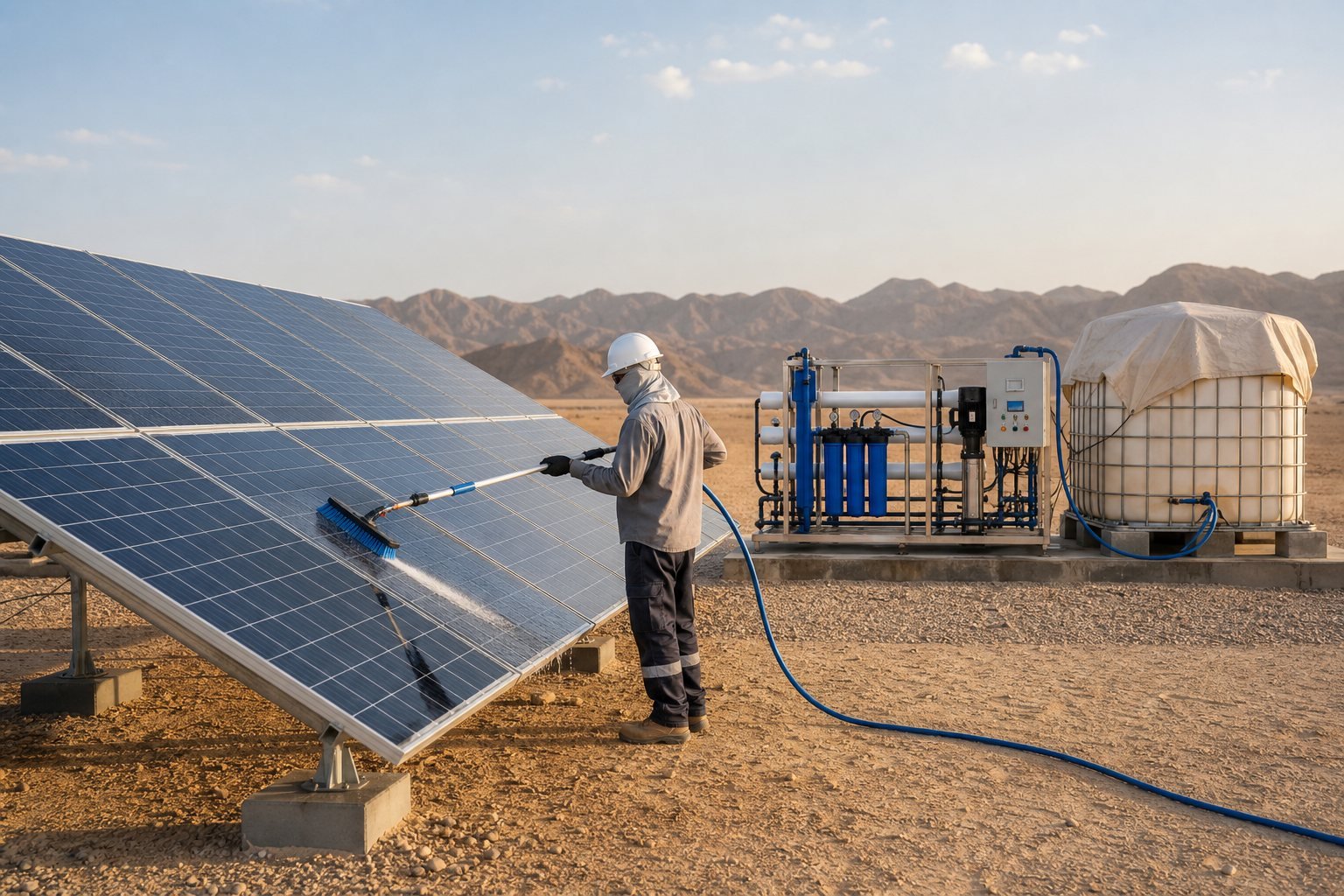
A trailer-mounted plant with its own tank, RO, DI vessel and generator suits contractors working across several sites, rooftop portfolios, and remote arrays with no reliable water point. It costs more per cubic metre and needs a discipline that fixed plants do not: someone has to log the TDS and flush the membranes after every move, or the unit arrives at the next site already fouled.
Running cost and maintenance of a solar panel cleaning water plant
- Cartridge filters — every 4 to 8 weeks on borewell feed, longer behind a well-run media filter.
- Media filter backwash — weekly, or on differential pressure. Skipping this is the fastest route to membrane fouling.
- Membrane CIP — every 6 to 12 months, sooner if normalised flux drops 10% or differential pressure rises 15%.
- Membrane replacement — 3 to 5 years with proper pretreatment; under 18 months without it.
- Mixed bed resin — swap on outlet TDS of the solar panel cleaning water, never on a calendar. Log the metre reading at every wash.
- Antiscalant — verify the dose rate against the actual feed analysis at least twice a year; feed chemistry shifts as borewells are drawn down.
Six mistakes we see on Omani solar sites
- Using raw tanker supply as solar panel cleaning water because “it looked clean”. Clarity says nothing about dissolved solids.
- No silica test in the feed analysis, so the plant is designed for hardness it can see and fails on the contaminant it cannot.
- Sizing the RO to hose flow rather than to daily demand with a buffer tank.
- No inline TDS meter at the lance, so exhausted resin runs undetected for a full shift.
- Washing at midday. Hot glass flashes the water off before it can carry the dust away, and thermal shock is a real risk on a 60°C module.
- No written solar panel cleaning water specification in the O&M contract, which leaves the asset owner with no basis to reject a bad wash.
Frequently asked questions
What TDS should solar panel cleaning water be?
Under 10 ppm is the practical spot-free threshold, and under 5 ppm is what we design for. RO alone typically lands between 15 and 40 ppm depending on feed, which is why the mixed bed polisher is there.
Can solar panel cleaning water be RO only, without a DI stage?
On low-TDS mains feed, a well-run RO can get close enough that spotting is minor on a rinse-and-squeegee method. On borewell feed it will not, and on any site where the panels are left to air dry, the DI polisher is what separates a clean array from a hazy one.
How often should panels be washed in Oman?
Site dependent. Most Omani arrays land on a 2 to 6 week cycle, tightened after shamal dust events and around construction or cement works. The right answer comes from tracking performance ratio against soiling, not from a fixed calendar.
Can detergent be used instead of pure water?
Most module manufacturers restrict or prohibit it, and surfactant residue attracts dust faster than clean glass does. Pure water plus mechanical action is the standard method. Where oily or cement deposits demand a chemical, clear it with the module manufacturer first and rinse with DI water afterwards.
What size plant does a 10 MW site need?
On a brush method and a three-week cycle, roughly 10 m³ of product per cycle. A 500 to 1,000 LPH RO with a DI polisher and a 10 m³ buffer tank covers it comfortably, with headroom for an unscheduled wash after a dust event.
Do you supply mobile units for cleaning contractors?
Yes. We build trailer and skid-mounted units with tank, RO, mixed bed vessel, delivery pump and inline TDS monitoring, sized to the module count and feed water you actually have.
Get a sized solar panel cleaning water system
Send us your feed water analysis, module count and wash cycle, and your solar panel cleaning water requirement, and we will return a sized design with the membrane projection, consumable schedule and every exclusion stated in writing. No margins, no catalogue numbers, just the specification. See our solar panel cleaning water system service page, our industrial RO plant guide, all water treatment services, or contact us on +968 9763 7786. Uniqueness View LLC is ISO 9001:2015 certified and registered with the Oman Tender Board and JSRS.
Related water treatment guides
Other stages of the same treatment train.